Showing posts with label Math Education. Show all posts

Monday, 15 February 2016

9 Things Primary and Secondary Teachers Can Teach One Another

"Are you kidding me? I could never do that. Those people are crazy."
-- Every high school teacher when asked if they'd ever consider teaching elementary.

"Are you kidding me? I could never do that. Those people are crazy."
-- Every elementary teacher when asked if they'd ever consider teaching high school.

In my first few years as teacher, I had a kindergarten teacher for a roommate.  Many an evening we would commiserate over the trials and tribulations of our respective positions.  She would tell me of her struggles with nose pickers and biters, and I would relay tales of angsty, full-of-attitude teenagers and the various layers of drama steeped in every hallway.  Each of us marveled at the other's ability to tolerate the intolerable, and would swear to never step foot into one another's arenas.

Life makes it's own plans, of course, and while I have remained professionally a high schooler my whole career, I have since become a father to four children who in their turns are marching their ways through elementary and middle school.  After an occasional class volunteering visit, and countless interactions with my kids and their seemingly endless hordes of neighborhood friends (some days I swear that my wife and I should be charging after-school care fees), I'm more convinced than ever that teaching primary school is not something I would be cut out for.

That said, I have had the good fortune to interact with elementary and middle school teachers a fair bit over these years.  Besides my own children's teachers, the online community is well populated with elementary teachers and some of the emerging social media formats that teachers are gravitating to are finding primary teachers as their early adopters.  Periscope and Blab are two broadcasting apps that are gaining mass appeal, and both of these platforms offer teachers some excellent opportunities to interact with colleagues around their jurisdictions, states and provinces, and the world as a whole.  But for a variety of reasons, both of these platforms seem far more heavily populated with teachers in the younger grades. So I find myself "hanging out" with some fabulous educators, but very few of them are in my teaching stratum.

And while I'm on the subject of the live broadcasting teacher community, I also want to take a moment to put a plug in for the growing teacher families on each of those media streams.  While the majority of teachers currently broadcasting live probably align fairly similarly with Pinterest's demographics (mostly female elementary teachers from the US), they are producing a lot of exciting, informative, and interesting content.  On any given night, you can log in to see people like Sheila Jane from sheilajaneteaching.com spreading missions of happiness and harmony.  Teachers Pay Teachers gurus not only hawk their wares, but share their secrets for growing businesses that help teachers justify hours of personal time spent developing content for their (and others') classrooms.  Education advocates and cheerleaders for student success and engagement share powerful stories of traditional and progressive classrooms around the world.  While these social media streams are in their infancy, I daresay that they might be the "Next Big Thing" in teacher professional networking.

But I digress...

Let me share some of the things we "bigs" can learn from the "littles" and vice versa, starting first with we high schoolers can offer the younger grades.

3 Things that "Littles" Teachers Can Learn From "Bigs" Teachers

1. Non-conformity

Most of these items I hope will be more on the positive side, but I'll start with one that is perhaps a little sour, so that we can end on a happy note.  I will illustrate with a story:

One day I came home from work to what I thought was an empty house.  After a couple minutes I realized that I could hear my aforementioned kindergarten-teaching roommate in the basement, which was unusual, because she was usually one to say hi when one of us came home.  I went down to see her, and as I approached the threshold of "her house" (she lived in the suited basement of my house, but we were well enough friends that the whole house was welcome to each of us), I could hear sniffling and the stilted breath of someone who had obviously been crying.

I peeked slowly around the corner, and asked "hey... you OK?"
She sobbed softly.  I sat beside her and gave her a hug, trying to figure out what this might be about.  She was quite upset.  Had someone passed away?  Had her boyfriend dumped her?  I waited for her to compose herself, and asked again what was troubling her.

"It's stupid," she replied sheepishly.
"It can't be THAT stupid if it's got you this upset.  What's up?"
"Shirley" (a colleague) "told Christine" (another colleague) "that my bulletin board... and this is how she put it... 'looks like someone let the resource kids be in charge of it.'"  

This brought on a renewal of tears, which was convenient for me because they caused her to miss the look of abject confusion on my face as I pondered how it could be possible that a second-hand critique of a teacher's bulletin boards by a colleague could warrant this much anxiety.

Apparently in elementary school, bulletin boards are a thing.

And I've since come to learn that just about everything else is too.  While it certainly isn't a universal truth about every school and every staff, I've come to learn that Keeping-Up-With-the-Joneses can be a very big deal in the younger grades.  That's not to say that it doesn't happen in upper levels, but we tend to have a much more difficult time (and thus perhaps a lesser tendency) of comparing one another across subject specialties.  I, quite frankly, don't have nearly as focussed a picture of what an excellent English/Language Arts classroom looks like as, say, a Science classroom.  Moreover, we expect that the Music teacher and the PE teacher will have very different personalities and skill sets, and while that might be a source for some good-natured (and sometimes not-so-good-natured) joking, diversity is sort of the norm in secondary school.

But in many elementary schools, there is apparently a "way" that everyone is more or less expected to be.  Whether it's how loud a classroom is, what's up on its walls, how much tech is being used, how a class lines up at the end of recess, or the quality of a grade's Christmas pageant offering, just about everything is fair game for scrutiny and judgement.

This may sound fairly accusatory, but it really is not meant to be.  I want to call it out because I desperately want teachers, no matter what their grade or subject level, to be helpful and supportive of one another.  I want this for more reasons than I can count -- for the mental health and well-being of my colleagues, my kids, and my society as a whole.  I want all teachers to feel like they have a chance to be themselves and to express themselves creatively through the contexts of their practices.  When we create, when we are able to be expressive of ourselves as a person, we can be at our best.

So I'm going to offer this to the primary teachers out there.  It's an outsider's advice, so I will take no offense if you tell me to stuff it:

Embrace your differences.  If you like how you're doing things, and they're working for your kids, great!  Keep doing it.  Yes, there's such a thing as best practice, but the notion that best practice looks the same in every room is simply incorrect.  Personalities factor in, and these differ from class to class, teacher to teacher.  Your colleagues can certainly be a source of inspiration and ideas, but the people you have to answer to and live up to are the ones who sit in the small desks in your room, not the ones who sit in the big desks outside of it.  Be your kids' hero, not your colleagues'.

If you do encounter differences in approach with a colleague who is producing results in their students learning (and please let's focus on that and not the window dressing that often gets critiqued instead) that is of lesser quality, then find the courage and compassion to support, nurture, and encourage that colleague with positivity and kindness.  If you can't do that, then kindly keep your opinions to yourself.


2. What You Need to Give Them Before You Give Them to Us

A dear friend asked me advice one day on how to approach the subject of homework with his daughter's grade 2 teacher.  Apparently his 7-year old was getting homework on almost a nightly basis, sometimes more than an hour's worth in a single evening.  He felt this was extreme for a grade 2, and wanted some advice on how to broach the subject from someone "on the inside."

I couldn't provide much advice beyond advising him to address the issue with the teacher before sending it up the flagpole to admin.  One thing I encouraged him to ask, however, was about the teacher's philosophical foundations regarding homework.  "Ask her what she thinks the students gain by doing the work she is assigning at home, rather than at school," I advised.  I encouraged this partially because it was a question for which I was myself curious to hear the answer.  Later on, he shared with me her response:

"We need to develop good study habits so they're ready when they get to high school."

You're probably giving your head as vigorous a shake as I did when I heard this reply.  Does a grade 2 teacher really feel compelled to prepare students for something that doesn't begin for another 7 or 8 years??  I am fully aware that this example is an exception among elementary teachers, and not the rule.  My own children have all received very reasonable amounts of homework at their respective grade levels in my opinion.  

That said, I have often come across the notion among teachers of all grades that students need to be habituated to certain norms in preparation for their future schooling, sometimes schooling that is particularly distant.  We high schoolers are equally guilty, "preparing" many more students for college and university careers that a significant percentage of them are never going to have (not only because some won't attend college, but also because many won't take classes in our particular subject area).

So primary teachers, I'd like to pass along a request from one upper level counterpart, and perhaps my fellow high schoolers will extrapolate similar advice:

The only grade you need to get your students ready for is their next grade.  That is all.  If you teach grade 2, please only get them ready for grade 3.  That's it.  Please let us worry about getting the 9th grader ready for 10th grade and so on.

And to teachers of every grade:  I appreciate that you are thinking of your student's future.  I am too.  But can I ask you to also think about his or her present?  If your class is only concerned with tomorrow, how can you ask them to be engaged with their learning today?  You might be able to match the importance of your work today with rewards you'll see down the road, but you have the benefit of a well-developed frontal lobe to help you make those connections.  Kids do not.  If you spend too much time preparing your students for my world, they're going to show up already hating it, and in that case any gains you've made in preparation will have been lost in their attitudes and motivation.

3. Math

I get it: Math isn't everyone's cup of tea.  More than any other subject area, Math gets treated as the one plain donut in a box of iced and jelly-filled goodness.  Certainly that's not true of every class and every teacher, and I know that there are plenty of innovative teachers who are doing amazing things at developing numeracy skills in young learners.

But I also know that it only takes one bad year in math for a kid to be completely turned off the subject, and, sadly, by the time they show up in their first high school math class, most kids have firmly made up their minds about the subject, and many have decided that they "just aren't any good at math" or that they "can't do math at all."

Part of this blame lays at the feet of math curriculum developers who adhere to antiquated notions about what K-12 students "need" in their math education.  But it may also lay at the feet of teachers who have strong reservations and misgivings about the subject.

If imparting a sense of numeracy is not your forte, may I humbly suggest checking out Jo Boaler's video series on the subject.  It's long, but absolutely fantastic, and as a non-native Math teacher, I found it to be game changing in my ability to convey math principles to students at their level.

6 Things that "Bigs" Teachers can Learn From "Littles" Teachers

First off, I want to say that it's no coincidence this list is longer.  Some high schoolers can be pretty high & mighty about being "on top" of the K-12 totem pole (and I've definitely been guilty of this), but we should really get out of our own ways and pay attention to the good things that are happening at the younger grades.  There's plenty that can be gleaned from their examples, and this is just a short list of things I've picked up directly from those wonderful primary teachers over the years:

1. Math (and Reading)

Didn't I just say that this was something the primary teachers need to learn from the high schoolers?  Yes, but there are plenty of elementary teachers who could be of significant benefit to even the most scholarly of high school math teachers as well.  And the same is true of literacy specialists in the younger grades and their English/Language Arts teaching counterparts up above.

We high schoolers come to the table with advanced subject specialties.  The math teachers, for instance, understand complex algebra, geometry, calculus, and statistics.  But do we all understand how to identify deficits in and impart very basic foundational skills in numeracy and literacy?  Not often enough, frankly.  

We teachers each have students in our classes who are struggling well below grade level in reading and math fluency.  All too often, these students see no advancement in their grade level achievement throughout high school unless they have specialized interventions in place with resources that are in limited supply in most schools.  We teachers have the ability to fill in those gaps if we come armed with an understanding of how.  But that understanding is often treated cursorily, if at all, in the secondary math and English programs of teacher colleges.

2. How Carefully Considered Their Spaces Are

I marvel at many elementary classrooms.  Every square inch is considered.  The walls.  The floors.  Sometimes even the ceilings.  It all has a purpose, it's all organized, and often the various corners of a room will have a very particular feel or nuance, perfectly adapted to the task intended to transpire there.  I need to learn this.

Presently, I'm just terrible at setting an emotional tone through my decor.  Growing up, I distinctly remember the "warm" classrooms I learned in and the "cold" ones.  In the warm ones I was more engaged, more relaxed, more welcome, and I simply learned better.  I realize the physical setup is not necessarily the only cause of those effects, but it's certainly one of them.  Following elementary teachers on Pinterest and Instagram has inspired me to make my classroom a better looking space, though I suspect I'll be asking for a lot of advice and guidance from them in the process.  That's okay too.

3. Teaching the Whole Child

This one isn't entirely our faults.  Most primary teachers start with a group of students and stay with them for a full year.  Most secondary teachers see their years divided into semesters & terms and their days divided into courses and periods.  Seeing 120 kids in a single day is by no means a rarity, and you might only see some of them for a couple of months in a year that is chopped into quarters.

Nevertheless, the most important thing we can do as educators is to connect with the kids in our rooms on a personal level.  Yes it's harder when they come and go so much.  Yes, it's hard when we feel the pressures of curricular goals and standardized testing looming over us.  But we need to fight that off and get to know our students on a personal level.

I've seen a few teachers toss out a statement on social media that goes something like this: "I teach students, not subjects."  It's getting to be a touch cliche, but I appreciate the sentiment.  We need to connect with our kids as humans, and not as IPP codes, or social stereotypes (jocks, etc.), or numbers in a grade book.  The moment we start stripping students of their humanity is the moment we license an administrator or a jurisdiction to strip us of ours.

4.  Exhibition

Whether it's with flashy bulletin boards, newsletters home, class performances, or projects to take back to mom and dad, primary teachers do a much better job at exhibiting the work of their students.  That's not to say we don't do this at all, but I think it's fair to say that we don't do it as much (at least not in the "core" subject areas -- my school's fine arts department would have some rather valid counterpoints to make here).  

I can't say enough about the importance of having students perform, exhibit, and share the work they do in school with others.  I have a whole other post coming that describes why the work has to matter more than the grade, so I won't get too carried away here, but exhibition is an important part of that concept.

Now you, dear high school teacher, might ask me "so you want me to hang the students' math worksheets on the walls?"  Nope.  No, I really don't.  I want us to find work for them to do that is worthy of hanging on the walls, taking home, and/or spreading to the world at large.  Again, that is the topic of a very different post.

5. Letting the Village Help Raise the Child

Volunteerism is alive and well in primary schools.  Granted in many schools it's mostly parents doing the volunteering, but for some reason that spirit all but vanishes in many communities by the time the high school years roll around.  I'll freely admit that the needs of a high school math class are substantially different than those of a kindergarten class (to say nothing of the average parent's potential to be of legitimate assistance in those two environments), but we still need to acknowledge that parent involvement in a lot of high schools is spartan at best.  Some of the blame may rest with moms & dads who are happy to finally be reclaiming some of their own lives back after years of bake sales and concerts, but there are plenty of parents who still want be involved, some desperately.  Does your school make it easy to find and make those connections?  Do you?

Beyond parents there are community members eager to share their expertise with students.  Doing a journalism unit in English?  Are there any journalists who might be able to share some insights?  Working on a projectile motion project in physics?  Is there an engineer who might be able to offer advice on student designs?  Making connections with the community and the world at large legitimizes the work we're asking our students to perform.  Finding outlets for parents to get more involved in the school community enriches the culture of the building and potentially affords teachers  the time to do the sorts of things that only we can really do.

6. Collaboration

Yes, I'm going to beat this dead horse some more.  Every grade level needs to ratchet this practice up more, but the primary folks are leading the way here.  Maybe they have a leg up because there is more uniformity in their practices than in ours, but whatever the reason, they're doing it better.  We need to get off our islands, get out of our comfort zones, and start dismantling the walls between subject areas and grade levels, even if it's just once in a while and only a little bit at a time.

In the early years of my teacher practice, I was very uncomfortable with opening my door to outsiders.  I didn't want them to see me for the fraud I often felt that I was as a teacher.  Yes, I did my job, but I often felt as though I didn't know how to do it well, and whatever accolades I received were as a result of what amounted to me as "smoke and mirrors."  I felt as though I was interspersing average teaching with little more than entertainment, and that I'd rather be seen as a good teacher than a bad one who was at least funny sometimes.

If you are like I was, suffering from what some call "Imposter Syndrome," you actually need to open your door more, not less.  The best way to get better at what you do is to talk openly and honestly with others who do the same kind of work, regardless of how much better or worse they are than you.  You need to see and be seen teaching, whether it's informally or formally.

*****

As teachers, as much as ever, we need to help build one another up and be supportive of each other.  This is a challenging job, and everyone who has stepped in front of a class is a kindred spirit.  Regardless of the age you teach, there is something to be learned and gained from interacting with other teachers.  Sometimes you'll be the one receiving the most benefit from these exchanges, and sometimes another person will.  But overall, our society and our world as a whole prospers when teachers get better at what they do and are more happy doing it.  Every single one of us has the ability to help bring out the best in one another, and in so doing we'll all be better at bringing out the best in our kids.

So I challenge you, dear reader, to listen first, to reserve your judgement, and to lead with compassion and kindness.

♥

Vive la revolution!!

Monday, 5 October 2015

Cleanup in the Pi Section

No one ever asks the art teacher or the music teacher "are we ever gonna use this in real life?"  When you take an art class, it's generally assumed that you're probably not going to use the skills and knowledge you develop in art in a pragmatic way.  A few students who show an aptitude might go on and make a career of it, but it's generally assumed that art class is for the aesthetic joy of art (whether or not a student actually experiences that joy might be another matter).

There are a few of you out there who will know what I'm talking about when I say that for some of us, the very same aesthetic resonance that takes place for artists when they create happens to us when we do math, solve problems or puzzles, play certain kinds of games, etc. 

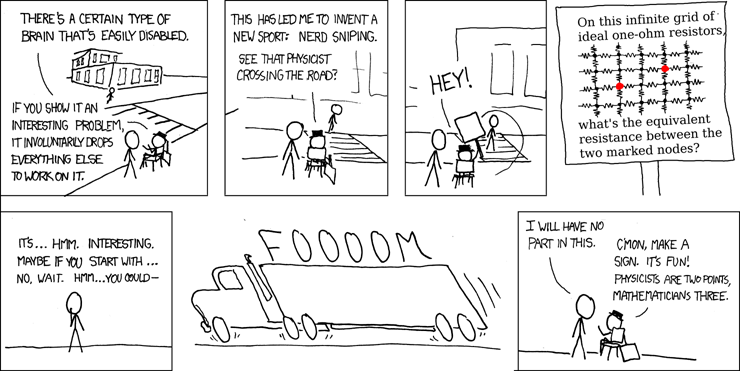
courtesy xkcd.com
Math teachers (and curriculum developers) are constantly defending the subject for its practical usefulness, even when the practicality of a topic is so limited as to be nearly indefensible.  I get it.  Not everyone is in to math, and at a certain point, they just want to know why the need for continued torture.  A few of us just want to solve challenging problems.

That's part of one of the challenges that I outlined in my last post.  In reality, it's a challenge for all schooling.  How do we design our programming so that the most engaged and able students are able to push the limits of their ability while at the same time allowing those who are less mathematically inclined to move in a positive direction?  I'm not sure I have the answer, but I'm at least going to try to suggest some starting points.

I'm going to start my "here's some things we should try doing in math" post with a mission statement of sorts.

I believe that Math education should allow each student to explore, understand, create, and communicate mathematically to the height of his or her potential.

It's a simple enough statement, but its execution may seem daunting.  How do you determine what the height of a student's potential is?  In what ways are they supposed to explore, understand, create, and communicate?  Why isn't there anything in there about learning?  In my mind, none of those details actually matter.  What matters is the statement acts as a litmus for all the other endeavors we pursue.  One only needs to ask this question: "Does this action promote each student's potential in math exploration, understanding, creation, or communication?"  I'm sure you could toss in a couple other nouns in there as well, but you get the point.

On the surface this seems like a waste of mental energy.  Isn't that what math curriculum and math classes are already designed to do?  That may be what the intent of the design is, but it is most certainly not the prevailing result.  I see disconnects between some of the practicalities of teaching the subject in our current schooling paradigm and maximizing learning for each kid.  "Each" is a very key word in that mission statement above.  The goal should be try to get every single student moving forward, and leaving no one behind, most particularly during the formative and foundational early years.

With that in mind, I'm going to pretend I'm the Emperor of Math Education for a day.  Here's where I would start, if I had unlimited ability and resources to effect change:

Suggestion #1:  


Research everything.  More specifically, I would direct a great deal of energy into nailing down the specifics on how the genuinely effective teachers seem to be getting their results.  I am almost certain that there are enough people out there doing an amazing job of teaching math that if we could simply collect and disseminate their wisdom efficiently, all would be right. 

The lines of communication between the research community and the teaching community are threadbare and one-directional.  The researchers are doing research, and some of that information is making it to teachers -- at least those who are keeping a watch out for it.  Very little information is making it back.  We do research every day into what works and what doesn't in our own classrooms, but rarely does that get documented and reported in a meaningful way back up the research chain.  Highly effective teachers may get recognized with awards or accolades, but how often are these folks given an opportunity to show the rest of us how it's done?  Not nearly often enough would be my answer.

All of that needs to change.

Suggestion #2:


Develop a plan for year-by-year remediation for students that are demonstrating weak foundational skills.  There needs to be methods and practices established for students who aren't operating "at grade level."  We do this for our English Language Learners who arrive at our schools from other countries or regions and don't speak the language fluently.  ELL students often receive resource help and/or alternative programming to assist them in their linguistic readiness.  This needs to occur across years and courses in math as well, and not just for students with identified learning disabilities.  Frequent revisiting of prior learning and reinforcement need to be part of every student's experience.

The anti-testing establishment will likely have a problem with me here, because it requires that we regularly measure student progress and ability.  I want to make a very fine point here: when I test it's to find out what I need to do as a teacher to help kids grow and learn.  That is what I believe the purpose of all testing should be at its root.  Government-issued testing also carries with it the "accountability" element we hear of in the media.  What that really means is that it's an indirect test of the teachers as much as a test of the students.  I'm neither ideologically for nor against this practice.  It all depends on how the information is gathered and used and what impact it has on student learning.

Whether the ongoing testing occurs inside individual classrooms in isolation as designed by one teacher or across entire school jurisdictions as standardized tests, the necessity of monitoring student's ongoing progress in math is vital.  Good assessment serves the learning process, and my goal here would be to identify those students who are starting a year or a course with holes in their skill-sets, steering them to resources that will fill those holes, and thus giving them a chance to be more successful at learning the incoming content.  Test early and act accordingly.

Suggestion #3


Personalize the learning for students as much as possible.  I recognize that this is very challenging, particularly in jr/sr high school where a single teacher can be responsible for the instruction of many dozens of pupils, often for fairly brief periods of time (perhaps a single 8-9 week term or a 16-17 week semester).  A teacher might be responsible for 3 to 6 different courses or grade levels at one time, never mind the total number of students they must attend to.  These, frankly, are all issues in their own right, and likely deserve careful design consideration.  One cannot honestly argue that a single person responsible for the differentiated and individualized instruction of 100+ students is going to be the most likely method for maximizing each student's potential.  Teamwork and collaboration here are minimally necessary.

Within the context of a single class, however, there are ways that teachers can vary learning.  Here are a few that I've either encountered or tried.  Note of course that the context here is a high school setting, so some suggestions may not fit in lower grade levels, and some that would be obvious at a younger grade might be missing.
  • Split formative work into multiple levels of difficulty.  Assign each section of work or question a "point value" based on difficulty or time needed to complete.  Have students work toward completing a certain number of points or difficulty levels.  More advanced students could be encouraged to do problems that challenge them more deeply while skipping the "no-brainers." 
  • Provide open ended tasks where there are multiple possible solutions and encourage students or groups to find as many as they can.
  • Use assessments, formative work, and projects that allow students to show reasoning and work in multiple ways.
  • Make use of online and flipped classroom resources (e.g. Khan Academy) to reinforce instruction or challenge more advanced learners.  These resources can also be used to allow students who are capable of accelerated learning to advance more rapidly, potentially freeing them up to work on projects that are more meaningful to their learning styles.
  • Model and make use of manipulatives and visual aids in small group settings for learners that are tactile, visual, and or expressive.
  • Make use of small group and paired settings for students who are interpersonal learners.  Pairing students who are eager to coach with those who prefer being coached is effective.
  • Record lessons, vlogs, tutorials, or problem walk-thrus for students to access independently.  This is especially handy when students are working at home or have missed classes.
  • Focus assessment and communication on outcomes and competencies.  When students are demonstrating their learning, responding only with percentages or letter grades doesn't sufficiently communicate where they are missing the goals.  Simply "going over the test" after may not be sufficient.  Structure grading so that it communicates how well students perform at each of the many competencies that might be tested on a particular summative assessment.  Don't just grade the test.  Grade the skills.

Suggestion #4:


Eliminate "failure" as a destination.  Reduce size and scope of summative assessments so that they can be generated quickly and repeatedly. Allow students to be as iterative in their math learning as they are in their creative pursuits. 


Suggestion #5:


Create "space" in timetabling and school structures for students to be able to complete course work outside of a "normal" time frame.  For example, a student might complete a single unit from a course in a subsequent year rather than repeating an entire course that they did not fully complete.

Suggestion #6:


Once students are past a point of being as mathematically literate as they need to be in order to function in everyday society, let students and their parents decide what kind of relationship they want to have with math going forward.  I can't say exactly when this should take place, but I have to think that it's somewhere around 8th or 9th grade.

Not everyone needs to do math.  There I said it.  Whew.  Felt good, but also a little sad.  By the time kids are well and truly into high school, there aren't many of them who don't have a pretty solid pulse on where math fits in their lives.  They might not know what they want to be when they grow up, but they probably have a pretty good idea whether that's going to include math.  If we're doing the kind of job we should be doing leading up to high school, and ensuring that as many kids as possible are reaching their mathematical potential, we'll still have plenty of students pursuing math courses.  If we're going to continue to offer vocational math programs for students who lack strong academic math skills, let's tie those programs in with vocational programming or other courses relevant to these students.  This is a stage where drill-and-kill really does.  Make it real; make it relevant.

Suggestion #7:  


Find really cool things to do in school that use Math.  My class builds houses.  Measurement, trigonometry, geometry, surface area, volume, and even a bit of algebra is a lot more worthwhile for both the math-inclined and the not so math inclined.  Naturally, we're not going to have every high school kid build houses.  So find your own houses.  One way to do that is to have your math teachers working directly with your teachers in other subjects.  Find the places where math fits and connect the dots.  No, you won't be able to complete every math objective that way.  But it'll make for a nice break from the everyday.

****


Many of these suggestions can be put to use in a typical math classroom.  But many of them speak to the need for structural changes in the ways that schools operate.  If we're going to shake it up... let's shake it all up.

I'm going to offer one last suggestion that's related but not in quite the same vein:

Get high school kids coding.


There are plenty of gamers who want to learn how to make games.  There are plenty of kids who find learning in games to be engaging.  I see a fit here.

TL;DR  There are a bunch of things I think that we can do make math education more effective and meaningful, leaving fewer kids behind.  If you want to know what they are, you'll probably have to actually read the post.

Vive la resistance!

Saturday, 3 October 2015

Pit Stop: Math

On the big ol Highway of Revolutionary Education Reform that I have embarked on some 5 blog posts ago, I'd like to take this moment to pull off the road at the next town, maybe grab a bite and a stretch, stock up on Doritos.  Every good road trip needs Doritos.  Let's pay a little visit to Mathville, shall we?
Population: undefined due to zero division

Before getting into it, I want to make a few qualifying declarations: my primary background is in science education.  I'm not a mathematician, and the highest level of math that I've taught formally (so tutoring notwithstanding) is 10th grade.  I can't honestly pretend to have a firm read on the pulse of math education, and attempts to get such a read have been a challenge.

For instance, a common thread in some of the literature I've tried to digest on Math Ed Reform is that research comparing progressive practices frequently involves teachers expertly trained in the methods being researched in the study, compared against control groups with teachers using traditional practices.  No mention is given to the level of expertise of the control groups in their own methodologies (how are we to be certain some of these aren't just generally bad teachers?), nor is a group studied involving teachers receiving a "typical" amount of training that might be offered a rank-and-file teacher through professional development within the context of an existing career.  In other words, I'm not totally sure I trust all the conclusions I read about progressive methodologies or their practical applicability.  Moreover, I don't have to look very far to find conflicting claims (as in the fourth article of this journal) by other research groups or by comparing our methods to those in countries that score well in international math assessments.

Additionally, my perspective is fairly limited to high school math education.  My sense of what's going on in elementary and middle/junior high schools is limited to a cursory appreciation of the curricular objectives, tidbits of professional literature, and in experiencing elementary math through the lens of a parent with kids in primary school (grade 6, grade 2, and grade 1, with a fourth kiddo still bumping around in diapers).

So now that we have established that I don't have much business telling math educators how to do their jobs, why then, would I pick this as a spot to weigh in on math?  A few reasons:
  • It's saucy.  What's a revolution without some controversy in it?  I don't think any issue in Ed Reform has gotten more mainstream media screen time than changes in math teaching.  This is especially true across the border where American backlash to their national Common Core standards have received considerable attention and opposition. 
  • Math test results evidently carry a lot of weight in the international scene.  Sorry humanities teachers!  The bean counters and politicians don't seem to give a rip if students in China are crushing us in Sonnet Deconstruction, but show them another dip in our annual PISA results and just watch the panic button take another beating.  Debate its merits at your leisure, but it's a pretty entrenched view that a nation good at math is a nation good at money.
  • There's no right answer (ironic, hey?).  I have no doubt I'll have some opposing opinions come my way, but no one can definitively say they know what needs to happen in Math Ed within the context of our existing education system.  It was declining scores and lack of math engagement that pushed for reform (which has arguably not worked) in the first place.  Debate me all you like, but proving me wrong is going to be a tall order.
  • Just because we don't clearly know WHAT to do, doesn't mean we don't agree that something needs doing.  Math scores are still declining (Alberta is particularly guilty here, and recent pedagogical shifts have come under scrutiny similar to that of the Common Core backlash), math and computer science enrollment has taken a beating, and Canadian students are less likely to take math-related programs than international students studying here.  We are most definitely NOT in an "if it ain't broke, don't fix it" head space.
  • It is interesting to me partly because some of the most insidious challenges appear to have solutions that require, at least in part, some manner of structural or design changes to the way we educate.  Imagining novel ways for schools to operate is a fun exercise (well... at least for weirdos like me).  Ironically, for all my bluster about the need for ground floor changes in my first post, this is an area where we might need a little help from the bigwigs to get just right.
  • It's the area in which I personally diverge in my views most significantly from progressive teaching ideology.  This is not because I don't believe in progressive ideas generally.  I just feel that embracing them in totality is throwing the baby out with the bathwater, at least insofar as math is concerned.  Why that is the case will become clear as I continue.
  • I like math, and I like teaching math.  It absolutely kills me to see kids step into my classes on day one having long ago decided that they suck at it, that they hate it, and that they will NEVER get it.  I will also add that getting a kid to turn a 180 on at least that last one is honestly one of the most satisfying things a teacher can experience.
Suffice to say that this is an issue that is near and dear to my heart, regardless of how qualified I am to comment on the subject.  To reiterate: I concede that I am far less qualified than other math educators to offer guidance on this topic.  But it is important enough to me that this post is already pushing 1,000 words, and I haven't even touched on what I think the problems are or what we can do about them.  For that reason, I'm going to split those two ideas into separate posts.

For now, the challenges:

Challenge #1:


Math has an incredibly high degree of internal dependency.  Early learning (or lack thereof) is highly determinant of the degree of learning (or lack thereof) in later stages.  A single year of bad math experiences for a student can be enough to derail their outlook on the subject permanently.  There are only two other subject areas (that I can think of) that can compete with math's degree of level dependencies: learning to read (literacy) and second language learning.  The similarity of learning numbers and learning words should not go unnoticed here.

Teachers of other subject areas have tried to debate me on this point, but none of them have even come close to convincing me that their subject areas require the same degree of mastery in prior courses as that of math.  I can learn about plant biology without having first studied chloroplast functions.  Understanding World War II is not critically dependent on understanding the American Civil War.


Challenge #2:


There are a significant number of professionals teaching math who have no formal training in math,  little to no training in math education, and their own negative dispositions toward mathematics.  Linda Pound, in her book Supporting Mathematical Development in the Early Years found this to be both commonplace and measurably impactful on student success in math.

Challenge #3:


There is a very pervasive undercurrent of thought that some kids (some people in fact) simply "can't do math."  A few very specific learning disabilities notwithstanding, this is verifiably false.
Granted, some kids learn at a more rapid pace, but everyone is capable of achieving in mathematics at a fairly high level.  This undercurrent, however, shapes not only our attitudes about teaching and learning but also the curricular structures in math as well.  By high school, we separate the kids who can from the kids who can't (or won't) and treat the latter as second class citizens, further reinforcing their attitudes about the subject by imposing trivial and anesthetizing objectives.

Challenge #4:


This one has endured a while:  Technology has the ability to stand in for foundational math skills and reasoning.  When a kid grabs a calculator to do 5 x 6, it has the potential to be far more detrimental than a failure to reinforce the memory of one small square on the multiplication table.  It eventually strips away the meaning of what it is to multiply.  If I don't understand what multiplication IS, later when I need to calculate area or volume, or isolate for a variable in algebra, the calculator isn't going to tell me when I should be performing that operation instead of dividing or adding.  Too often, I have seen students blindly pecking away at their calculators hoping that an answer will magically appear without any clue whatsover as to why they are pressing the buttons in the first place.  And the worst part of it all is that I frequently see math resources (textbooks) and instruction that explicitly reinforces this broken pedagogy.  When technology moves beyond simply being a tool for efficiency and instead becomes something akin to magic, progress in math becomes seriously impaired.

Number sense is one of the most fundamentally critical components of math learning, and it has been utterly eroded by little mechanical boxes and, more recently, the dulcet tones of Siri, who will cheerfully answer my math questions without my needing to think OR type.  (By the way, if you've never asked her what zero divided by zero is, you're going to want to give that a go.)

Challenge #5: 


The spectrum of math ability among students, particularly in high school, can be vast.  One size-fits all models of instruction and assessment only serve the slice of students roughly in the middle of the ability scale.  Advanced students go unchallenged to seek out their genuine potential, while weak students are further outpaced and marginalized. 

Challenge #6:


Progressive learning models applied in math have received highly mixed reviews, show conflicting (or no) empirical data with regards to efficacy, and resist incorporation with other advanced learning models. Inquiry-based models and discovery learning can be highly engaging to already skilled learners, but can reach a ceiling with students who do not have a fully developed library of tools with which to approach the inquiry.

I recently visited High Tech High in San Diego, where I witnessed not only the deepest foray into progressive teaching and school design I have ever seen, but also (by far) the most effective.  This school was recently the subject of a tremendously interesting documentary, Most Likely to Succeed, and I cannot adequately express the importance of seeing this film if you are a high school teacher wondering what else school might look like.

While there, I had the good fortune of meeting with math teachers and observing classes in action.  There, teachers articulated the challenges of including math in cross-curricular project-based learning (PBL).  The most significant of these challenges was that projects that had to be married with other disciplines were limited in terms of how far the math could be taken before they simply outstripped the meaningful connections with the other subject.  Additionally, there was the significant challenge of exhibiting (a crucial component of PBL) projects to a public audience who does not have a similar level of understanding or appreciation for the subject matter.

That said, among the activities that I saw kids undertaking at HTH was good old fashioned worksheets.  When I asked one student about her experiences, she described it this way: "our major project uses a lot of what we're doing in math, but some things we just have to do the 'old-fashioned way.' I actually like it, though, because it's the one time of day where we don't have think about this huge project that's going to happen weeks from now.  I can focus on this one small thing for a little while and it's not so overwhelming."  Ironic that in her school it's the math class where she goes to escape the overwhelming.

Challenges 5 & 6 Taken Together:


Traditional "Drill & Kill" models are not effective in the cultural environment of North America (and many other western countries).  Progressive models, however, have failed to prove themselves to be the superior alternative.  Either a third model that hybridizes the best of the two or some completely new paradigm entirely is required.

***

That is by no means an exhaustive list of the difficulties facing math education.  They are the most pressing ones, however, that I feel I can frame an agenda for what direction I'd like to see math education take, both for me as a teacher and for my own kids as learners.


Next up, what we might do about it all.

TL;DR: Math is a big deal.  It's self-dependent, sometimes poorly taught and supported, challenging for kids once they get off track, impaired as much by technology as helped by it, traditionally serving only the median, and progressively serving only the gifted, and it still needs fixing after at least 30 years of apparently needing fixing.

Vive la resistance?