Thursday, 15 October 2015
A Day in the Life -- Building Futures
Just a quick post today of a little video that we put together to showcase our Building Futures kids. This particular video perhaps isn't the best example of how hands-on things can be for our kids. Feel free to poke around the videos in the rest of my channel to see some examples that are even more involved.

Friday, 9 October 2015
It Does a Teacher Good
I struggled with Project Based and Inquiry Learning for years. I mean... I did some of it. I always had the best of intentions for having kids working on engaging, interesting projects that gave them personal choice and (at least hopefully) motivation to do do their very best work.
Years ago our school's science department ran an annual research symposium that we called "Festivus." The name was a vicious ripoff of a Seinfeld bit, and the name was about the only thing that our event had in common with Frank Costanza's made-up holiday. It was a reasonably cool thing. Kids would prepare presentations on a scientific research topic of their choice in 11th grade across 3 different subjects. Students could even work with partners in other classes. We would invite members of the scientific community and academia to come and judge the presentations. Students would get all dressed up and we'd make an evening of it. Pretty progressive for being over a dozen years ago, hey?

What ever happened to it? Quite simply, we axed it. It was just too much work. The coordination and communication of all the judges was hours upon hours of work alone. But that extra effort would have been tolerable had it not been for what the project did to the rest of our classes. We set aside multiple class days for students to research and prepare their talks. Each presentation required a visual, so triboards and PowerPoints all needed to be completed. All the talks were dry-ran in front of peers for feedback before the "real thing." Hours of in-class and out-of-class time was spent perfecting the research, its synthesis, and its presentation.
But once we were done squeezing open our semesters to fit in Festivus, we then had to race like mad to stand-and-deliver our way through to completing all our course objectives in time for final exams. It was exhausting. We poured all this time and energy into a two to three week project only to pretty much destroy the other 14 or 15 weeks of our terms. It was hard on the kids, and hard on us.
Where had we gone wrong? Was Festivus a waste of time? Certainly, in retrospect, I'd have changed a few things, but more recently I've realized that it wasn't Festivus that needed to change. It was the rest of the semester.
It's taken some time, but I've come to realize that the exclusive use of teacher-centered methods, while safe, familiar, and comfortable are ultimately as bad for my mental health as for that of my students'. The body of literature extolling the virtues of progressive education models for students is massive. I'll concede that the jury (at least the scientifically supported with data jury) is still out on many progressive methodologies as far as their efficacy for students goes. In this post, however, I'd like to share my equally unsupported with data theory that certain progressive methods are good for teachers too. That is, they offer us both the opportunity to be more effective teachers, but they also give us the opportunity to do a better job of balancing our work lives and non-work lives.
I'm not going to try to bite off every progressive method. Some are more illustrative than others, and I'm already wordy enough. Let me, however illustrate why adoption of certain progressive habits makes such a big difference in the life of the average educator:
I've already expressed my insistence that this is the most important systemic change required in education today, so I shouldn't need to beat the horse much "deader." That said, I've got one of the most salient and juicy sales pitches to you teachers still on the fence about this one:
No Sub Plans.
I'll give you a sec to let that sink in... Go ahead... Let it rattle around a bit.
Picture this: it's a Tuesday morning. You wake up and your head is pounding, your throat feels like it is harboring tiny porcupines, and your sinuses are so runny, you're considering crushing up Sinutab tablets and just snorting them Scarface style. You need to call in a sub. Your options are to frantically type out a set of plans for them in the desperate hope that the day won't just wind up being a complete write-off for your kids or just sucking it up and heading in despite the likelihood you will spread this plague to every colleague and student who passes within a meter of you.
But what if instead, you've got a partner teacher or two that you're cohorting with at school? Well then it's nothing more than a simple phone call: "sorry to do this to you, but I've got the plague. Can you handle them today?" They tell you it's no problem and you settle in with a pack of Dayquil and enough Dristan to unclog a toilet without a second thought to what's not happening in your classes. Down the road, you'll probably return the favor, and you'll be happy to do it, for you'll understand the wisdom that is not living on an island as a teacher.
I bet there will be people reading this who will want to make a shift for this benefit alone (I too loathe doing up sub plans). So I don't even have to go into the value of being able to trade off shouldering the kids for a period while your partner gets caught up on some marking or planning. Or having an extra set of eyes in the room when you're trying to manage a number of smaller group discussions. Or being able to meet privately with kids to give feedback or assess while the other teacher is managing a larger discussion. Et cetera, et cetera, et cetera. Trust me gang... you want this in your lives.
Finding experts, allies, initiatives, and partners outside your school's walls is powerful for a lot of reasons. Some of the unmentioned reasons include the fact that it gives you the teacher an opportunity to learn alongside your students. Going into a "field experience" with a limitation on your own understanding puts you in the position that your students are in. That is a truly invaluable perspective and may even allow you to better refine your own teaching practices in light of what you learn by taking on the role of learner.
It also potentially offers you more productivity in your day. For instance, if you've brought in a carpenter to help your physics students design and construct their projectile hurling objects, that potentially provides you with more freedom to work with students who are struggling a bit more with the physics behind their trebuchets. The saying goes that "many hands make for light work," but in this context, it also makes for better work.
I may or may not do a post on Project Based Learning down the road, but it won't be a How-To if I do go there. That's because there is such a wealth of internet resources on the subject, that there is no way that I would be able to approach the quality and quantity of even a thin slice of the best sites. If I do a PBL post, it will likely be more of a "hey just because you're doing PBL, doesn't mean you stop teaching" post.
Being an effective PBL teacher can also very liberating. One of the things that doing a lot of PBL forces you to do is to take stock of all the little bits of work you used to make kids do before your PBL-life. Sitting down with your curriculum and your resources and carefully asking yourself (or better yet, asking your learning team) why you make kids do the things that you make them do, and being very honest about your answers, will often reveal that your students probably do a lot of busy work. It's probably very well designed busy work, but having both done this exercise and seen other educators do this exercise in a number of different settings, I'm reasonably convinced that most of us will find that there is actually a lot of fat to trim in most of the classes we teach. Replacing that fat with engaging, intense, visible, connected, and relevant project or inquiry work releases you from a lot of that paper burden.
I often advise my students that it's not just about working hard, but about working smart -- making the most of the time you have and getting maximum bang for your buck. I used to do that while carrying around stacks and stacks of marking that often didn't get completed until a final exam break started and I would finally have time to catch up on it all. What hypocrisy. More recently I've started taking my own advice and have learned how to give more precise and useful feedback with less paper coming home with me. Emphasizing quality of assessment over quantity of assessment can make for better and more efficient feedback with less paper to take home each day.

Having students exhibit and present their work to an audience outside the school environment is tremendously powerful for improving productivity and buy-in from students. But we also can't deny its effect on us either. When we invite our stakeholders in to observe our kids, we invite them in to observe us as well. That layer of accountability works for us too, and I think it's a good thing. And let's not also forget that feedback, whether bad or good can be valuable. We can't ignore the positive bump in job satisfaction that comes with hearing a thank you from a parent who is thrilled with the work their son or daughter has done in your class.
Additionally, exhibiting also gives us an all-important avenue for making more community connections. It's part of the networking process that I think will be essential to effective 21st century education. Inviting even just your students' parents in to see the display of student work throughout the year might just supply you with the connection for the next great project or partnership.

*****
TL;DR: Are the pressures of teaching driving you to an early grave, or at least an early retirement? Collaborate with colleagues, make connections in your community, shift to more student-centered practices, and exhibit their (and your) learning. Then enjoy your new lease on life and the career you imagined back when you first applied to teacher college!
Vive la revolution!!
Years ago our school's science department ran an annual research symposium that we called "Festivus." The name was a vicious ripoff of a Seinfeld bit, and the name was about the only thing that our event had in common with Frank Costanza's made-up holiday. It was a reasonably cool thing. Kids would prepare presentations on a scientific research topic of their choice in 11th grade across 3 different subjects. Students could even work with partners in other classes. We would invite members of the scientific community and academia to come and judge the presentations. Students would get all dressed up and we'd make an evening of it. Pretty progressive for being over a dozen years ago, hey?
What ever happened to it? Quite simply, we axed it. It was just too much work. The coordination and communication of all the judges was hours upon hours of work alone. But that extra effort would have been tolerable had it not been for what the project did to the rest of our classes. We set aside multiple class days for students to research and prepare their talks. Each presentation required a visual, so triboards and PowerPoints all needed to be completed. All the talks were dry-ran in front of peers for feedback before the "real thing." Hours of in-class and out-of-class time was spent perfecting the research, its synthesis, and its presentation.
But once we were done squeezing open our semesters to fit in Festivus, we then had to race like mad to stand-and-deliver our way through to completing all our course objectives in time for final exams. It was exhausting. We poured all this time and energy into a two to three week project only to pretty much destroy the other 14 or 15 weeks of our terms. It was hard on the kids, and hard on us.
Where had we gone wrong? Was Festivus a waste of time? Certainly, in retrospect, I'd have changed a few things, but more recently I've realized that it wasn't Festivus that needed to change. It was the rest of the semester.
It's taken some time, but I've come to realize that the exclusive use of teacher-centered methods, while safe, familiar, and comfortable are ultimately as bad for my mental health as for that of my students'. The body of literature extolling the virtues of progressive education models for students is massive. I'll concede that the jury (at least the scientifically supported with data jury) is still out on many progressive methodologies as far as their efficacy for students goes. In this post, however, I'd like to share my equally unsupported with data theory that certain progressive methods are good for teachers too. That is, they offer us both the opportunity to be more effective teachers, but they also give us the opportunity to do a better job of balancing our work lives and non-work lives.
I'm not going to try to bite off every progressive method. Some are more illustrative than others, and I'm already wordy enough. Let me, however illustrate why adoption of certain progressive habits makes such a big difference in the life of the average educator:
Team Teaching:
I've already expressed my insistence that this is the most important systemic change required in education today, so I shouldn't need to beat the horse much "deader." That said, I've got one of the most salient and juicy sales pitches to you teachers still on the fence about this one:
No Sub Plans.
I'll give you a sec to let that sink in... Go ahead... Let it rattle around a bit.
Picture this: it's a Tuesday morning. You wake up and your head is pounding, your throat feels like it is harboring tiny porcupines, and your sinuses are so runny, you're considering crushing up Sinutab tablets and just snorting them Scarface style. You need to call in a sub. Your options are to frantically type out a set of plans for them in the desperate hope that the day won't just wind up being a complete write-off for your kids or just sucking it up and heading in despite the likelihood you will spread this plague to every colleague and student who passes within a meter of you.
But what if instead, you've got a partner teacher or two that you're cohorting with at school? Well then it's nothing more than a simple phone call: "sorry to do this to you, but I've got the plague. Can you handle them today?" They tell you it's no problem and you settle in with a pack of Dayquil and enough Dristan to unclog a toilet without a second thought to what's not happening in your classes. Down the road, you'll probably return the favor, and you'll be happy to do it, for you'll understand the wisdom that is not living on an island as a teacher.
I bet there will be people reading this who will want to make a shift for this benefit alone (I too loathe doing up sub plans). So I don't even have to go into the value of being able to trade off shouldering the kids for a period while your partner gets caught up on some marking or planning. Or having an extra set of eyes in the room when you're trying to manage a number of smaller group discussions. Or being able to meet privately with kids to give feedback or assess while the other teacher is managing a larger discussion. Et cetera, et cetera, et cetera. Trust me gang... you want this in your lives.
Making Community Connections:
Finding experts, allies, initiatives, and partners outside your school's walls is powerful for a lot of reasons. Some of the unmentioned reasons include the fact that it gives you the teacher an opportunity to learn alongside your students. Going into a "field experience" with a limitation on your own understanding puts you in the position that your students are in. That is a truly invaluable perspective and may even allow you to better refine your own teaching practices in light of what you learn by taking on the role of learner.
It also potentially offers you more productivity in your day. For instance, if you've brought in a carpenter to help your physics students design and construct their projectile hurling objects, that potentially provides you with more freedom to work with students who are struggling a bit more with the physics behind their trebuchets. The saying goes that "many hands make for light work," but in this context, it also makes for better work.
Projects:
I may or may not do a post on Project Based Learning down the road, but it won't be a How-To if I do go there. That's because there is such a wealth of internet resources on the subject, that there is no way that I would be able to approach the quality and quantity of even a thin slice of the best sites. If I do a PBL post, it will likely be more of a "hey just because you're doing PBL, doesn't mean you stop teaching" post.
Being an effective PBL teacher can also very liberating. One of the things that doing a lot of PBL forces you to do is to take stock of all the little bits of work you used to make kids do before your PBL-life. Sitting down with your curriculum and your resources and carefully asking yourself (or better yet, asking your learning team) why you make kids do the things that you make them do, and being very honest about your answers, will often reveal that your students probably do a lot of busy work. It's probably very well designed busy work, but having both done this exercise and seen other educators do this exercise in a number of different settings, I'm reasonably convinced that most of us will find that there is actually a lot of fat to trim in most of the classes we teach. Replacing that fat with engaging, intense, visible, connected, and relevant project or inquiry work releases you from a lot of that paper burden.
I often advise my students that it's not just about working hard, but about working smart -- making the most of the time you have and getting maximum bang for your buck. I used to do that while carrying around stacks and stacks of marking that often didn't get completed until a final exam break started and I would finally have time to catch up on it all. What hypocrisy. More recently I've started taking my own advice and have learned how to give more precise and useful feedback with less paper coming home with me. Emphasizing quality of assessment over quantity of assessment can make for better and more efficient feedback with less paper to take home each day.

Making Learning Visible:
Having students exhibit and present their work to an audience outside the school environment is tremendously powerful for improving productivity and buy-in from students. But we also can't deny its effect on us either. When we invite our stakeholders in to observe our kids, we invite them in to observe us as well. That layer of accountability works for us too, and I think it's a good thing. And let's not also forget that feedback, whether bad or good can be valuable. We can't ignore the positive bump in job satisfaction that comes with hearing a thank you from a parent who is thrilled with the work their son or daughter has done in your class.
Additionally, exhibiting also gives us an all-important avenue for making more community connections. It's part of the networking process that I think will be essential to effective 21st century education. Inviting even just your students' parents in to see the display of student work throughout the year might just supply you with the connection for the next great project or partnership.

*****
TL;DR: Are the pressures of teaching driving you to an early grave, or at least an early retirement? Collaborate with colleagues, make connections in your community, shift to more student-centered practices, and exhibit their (and your) learning. Then enjoy your new lease on life and the career you imagined back when you first applied to teacher college!
Vive la revolution!!
Tuesday, 6 October 2015
It's Not About the House
I've blogged about the program in which I teach on more than a few occasions. "Yeah yeah," you say "Your class is great. Whoop-dee-doo. I don't teach in a class like that. What good is it to me?" Today that is just what I want to talk about. You see, the revolution is not about the class I teach or the project we're doing. It's not about the house. There are a lot of reasons why I like the spot I'm in, but today I want to talk about changing the spot you are in (assuming, of course, that you are a teacher).
 I genuinely believe that an effective model of pedagogical change can be layered on top of just about any curriculum. I say "just about" because I very much recognize the specter of high-stakes tests that loom over many jurisdictions. At some point down the road, I'm going to try to make an argument for why teachers should stop putting so much energy in prepping kids for those things, even if nothing changes regarding their role, weight, value, design, or use in your jurisdiction. But for now, let me just say that I understand where you're coming from in not wanting to let kids down on those tests. Alberta Diploma Exams, for instance, are a real thing and we can't ignore their impact on our students.
Outside of that mindset, however, I'm going to challenge any teacher who wants to make an impactful and positive change for their students, for their career, and for their outlook for the future, to head in some or all of the following directions.
Find a buddy, or maybe a few buddies that you think (a) are also looking to shake things up and that (b) you can work with amicably. We'll deal with the non-amicable folks later. For now, let's get people together who are drinking the same brand of Kool-Aid.
Sit down with your friend or friends over some coffees, perhaps some delicious baked goods. If a bottle of wine or a case of beer is more to your liking, have at 'er. Good food & drink always helps to make an experience even more rewarding. Bring some pads of paper, or maybe even chart paper or whiteboards (perhaps now the title of this blog will make some sense -- whiteboards and a few tasty beverages are all you need to start your own corner of the revolution).
Where the conversation goes from here is up to you. The goal: find an excuse to teach the same kids at the same time. The "Next Level" goal: The excuse will offer a novel, engaging, meaningful experience that gives your students an opportunity to create something that is meaningful and relevant to them -- work that they can take pride in beyond just showing mom and dad the letter on the report card. Maybe you look at ways to merge your classes for a large project or field experience. Perhaps you see if team teaching all or part of course makes sense. Maybe you think about a large-scale project that has tons of flash, redefines what it means for students to learn, and launches you into a completely new and exciting trajectory in your career. Either way, put it all out there on the table. Throw up the ideas on the wall and see what sticks. Find out where your teaching spheres collide and crossover. Find out where your passions and interests as educators and as humans crossover. Ask yourselves how would you do things if you had the freedom to do it the way you wanted? In the end, you'll hopefully have at least one idea that finds you impassioned and inspired to take the next step.
Before you take the next step, I want to add one piece of advice: It has been my observation that as the educational landscape shifts, stakeholders are carving out their individual niches whether it be within individual schools or educational jurisdictions at large. Many schools and school divisions want to be able to demonstrate their forward progress and commitment to improving education for the kids put in their care. The shinier the penny, the more easy it is to show off. I'm not saying that you should do things just to show off. But, frankly, if you want to get buy-in from the people you're going to need to ask permission from, you may need to give them a compelling reason to break from the tried and true. You'll have to gauge the climate and culture of your own setting, but personally I'd rather err of side of ambitious. If you offer them a plan that has the potential to showcase your school or division as exceptional, your chances of getting approval will likely increase.
Figure out what it will take to make it happen. This is obviously a big step. You don't just snap your fingers and marvel at the plan that appears before you. But this is where some exciting stuff happens. It's where these questions get answered:
Those last couple questions are ultimately about pedagogy -- about re-framing what you already do into what needs to be done. For some teachers, it's going to be the most significant barrier. There was certainly a point in my career where I simply couldn't have done this kind of work. Finding teammates who are already headed in this direction -- whether they're in your school, jurisdiction, or web browser is also part of the process. Last question: Who can help me? Don't have an answer to that one? Start here.
Make your pitch. Whether its a department head, a principal, a superintendent, a learning specialist, a parent council, or a politician, someone probably needs to hear the proposal. There are probably a whole host of things these folks will think they want to know in advance. Cost, manpower, time frames, impact on other areas of the school or school system, etc. Ultimately, though, three things are going to win you their approval:
(1) A compelling emotional reason to get on board. Who will this make an impact on and how big could that impact be? Tell the story.
(2) A degree of certainty that their own jobs aren't going to be made substantially more difficult by the change.
(3) A plan of action.*
Congratulations! You've got an exciting new project under way. Now the fun really begins.
Does it all seem like far more work than you've got time to manage? Objection noted. In my next post, I'll try to explain why I think the more you do this, the more you'll be able to shift your work load away from the ever mounting prep & grade cycle toward work that is more meaningful to your students. Don't get me wrong: there will be some hours invested on the front end to be sure. But crafted properly, the kind of projects that will have the most meaningful positive impacts on your students will also have the most meaningful impacts on your work/life balance. Done right, the revolution can work for your students and for you.
TL;DR: Join the revolution! Find friends, brainstorm, smash together your classes, design a project at the intersection of your subject matter and/or your interests, take time to plan, pitch it to your gatekeepers, profit!
Vive la resistance!!
* Credit where it's due: Switch: How to Change Things When Change is Hard by Chip & Dan Heath is owed for helping me to understand this.

Outside of that mindset, however, I'm going to challenge any teacher who wants to make an impactful and positive change for their students, for their career, and for their outlook for the future, to head in some or all of the following directions.
First...
Find a buddy, or maybe a few buddies that you think (a) are also looking to shake things up and that (b) you can work with amicably. We'll deal with the non-amicable folks later. For now, let's get people together who are drinking the same brand of Kool-Aid.
Sit down with your friend or friends over some coffees, perhaps some delicious baked goods. If a bottle of wine or a case of beer is more to your liking, have at 'er. Good food & drink always helps to make an experience even more rewarding. Bring some pads of paper, or maybe even chart paper or whiteboards (perhaps now the title of this blog will make some sense -- whiteboards and a few tasty beverages are all you need to start your own corner of the revolution).
Where the conversation goes from here is up to you. The goal: find an excuse to teach the same kids at the same time. The "Next Level" goal: The excuse will offer a novel, engaging, meaningful experience that gives your students an opportunity to create something that is meaningful and relevant to them -- work that they can take pride in beyond just showing mom and dad the letter on the report card. Maybe you look at ways to merge your classes for a large project or field experience. Perhaps you see if team teaching all or part of course makes sense. Maybe you think about a large-scale project that has tons of flash, redefines what it means for students to learn, and launches you into a completely new and exciting trajectory in your career. Either way, put it all out there on the table. Throw up the ideas on the wall and see what sticks. Find out where your teaching spheres collide and crossover. Find out where your passions and interests as educators and as humans crossover. Ask yourselves how would you do things if you had the freedom to do it the way you wanted? In the end, you'll hopefully have at least one idea that finds you impassioned and inspired to take the next step.
Before you take the next step, I want to add one piece of advice: It has been my observation that as the educational landscape shifts, stakeholders are carving out their individual niches whether it be within individual schools or educational jurisdictions at large. Many schools and school divisions want to be able to demonstrate their forward progress and commitment to improving education for the kids put in their care. The shinier the penny, the more easy it is to show off. I'm not saying that you should do things just to show off. But, frankly, if you want to get buy-in from the people you're going to need to ask permission from, you may need to give them a compelling reason to break from the tried and true. You'll have to gauge the climate and culture of your own setting, but personally I'd rather err of side of ambitious. If you offer them a plan that has the potential to showcase your school or division as exceptional, your chances of getting approval will likely increase.
Then...
Figure out what it will take to make it happen. This is obviously a big step. You don't just snap your fingers and marvel at the plan that appears before you. But this is where some exciting stuff happens. It's where these questions get answered:
- Who needs to approve the plan? How do we convince them that it's good for kids and that it's good for them too?
- Who might we need to partner with in order to bring this plan to life? Industry? Small business? NGOs? Non-profits? Academia? A few parents? Partners might not always seem essential, but I'd like to suggest that they certainly have the potential to be essential. The greater your idea's scope, the more hands will be needed to bring it to life. Finding essential partners will have to be a whole future blog post (these are really starting to accumulate).
- How do we find these partners and how do we ask them to get involved?
- How do we fit this work into the existing structure of our school (or do we need structures to change in order to make this work)?
- How do we make space within the work we already do in order to accommodate this new thing?
Those last couple questions are ultimately about pedagogy -- about re-framing what you already do into what needs to be done. For some teachers, it's going to be the most significant barrier. There was certainly a point in my career where I simply couldn't have done this kind of work. Finding teammates who are already headed in this direction -- whether they're in your school, jurisdiction, or web browser is also part of the process. Last question: Who can help me? Don't have an answer to that one? Start here.
Lastly...
Make your pitch. Whether its a department head, a principal, a superintendent, a learning specialist, a parent council, or a politician, someone probably needs to hear the proposal. There are probably a whole host of things these folks will think they want to know in advance. Cost, manpower, time frames, impact on other areas of the school or school system, etc. Ultimately, though, three things are going to win you their approval:
(1) A compelling emotional reason to get on board. Who will this make an impact on and how big could that impact be? Tell the story.
(2) A degree of certainty that their own jobs aren't going to be made substantially more difficult by the change.
(3) A plan of action.*
Congratulations! You've got an exciting new project under way. Now the fun really begins.
Does it all seem like far more work than you've got time to manage? Objection noted. In my next post, I'll try to explain why I think the more you do this, the more you'll be able to shift your work load away from the ever mounting prep & grade cycle toward work that is more meaningful to your students. Don't get me wrong: there will be some hours invested on the front end to be sure. But crafted properly, the kind of projects that will have the most meaningful positive impacts on your students will also have the most meaningful impacts on your work/life balance. Done right, the revolution can work for your students and for you.
TL;DR: Join the revolution! Find friends, brainstorm, smash together your classes, design a project at the intersection of your subject matter and/or your interests, take time to plan, pitch it to your gatekeepers, profit!
Vive la resistance!!
* Credit where it's due: Switch: How to Change Things When Change is Hard by Chip & Dan Heath is owed for helping me to understand this.
Monday, 5 October 2015
Cleanup in the Pi Section
No one ever asks the art teacher or the music teacher "are we ever gonna use this in real life?" When you take an art class, it's generally assumed that you're probably not going to use the skills and knowledge you develop in art in a pragmatic way. A few students who show an aptitude might go on and make a career of it, but it's generally assumed that art class is for the aesthetic joy of art (whether or not a student actually experiences that joy might be another matter).
There are a few of you out there who will know what I'm talking about when I say that for some of us, the very same aesthetic resonance that takes place for artists when they create happens to us when we do math, solve problems or puzzles, play certain kinds of games, etc.
Math teachers (and curriculum developers) are constantly defending the subject for its practical usefulness, even when the practicality of a topic is so limited as to be nearly indefensible. I get it. Not everyone is in to math, and at a certain point, they just want to know why the need for continued torture. A few of us just want to solve challenging problems.
That's part of one of the challenges that I outlined in my last post. In reality, it's a challenge for all schooling. How do we design our programming so that the most engaged and able students are able to push the limits of their ability while at the same time allowing those who are less mathematically inclined to move in a positive direction? I'm not sure I have the answer, but I'm at least going to try to suggest some starting points.
I'm going to start my "here's some things we should try doing in math" post with a mission statement of sorts.
I believe that Math education should allow each student to explore, understand, create, and communicate mathematically to the height of his or her potential.
It's a simple enough statement, but its execution may seem daunting. How do you determine what the height of a student's potential is? In what ways are they supposed to explore, understand, create, and communicate? Why isn't there anything in there about learning? In my mind, none of those details actually matter. What matters is the statement acts as a litmus for all the other endeavors we pursue. One only needs to ask this question: "Does this action promote each student's potential in math exploration, understanding, creation, or communication?" I'm sure you could toss in a couple other nouns in there as well, but you get the point.
On the surface this seems like a waste of mental energy. Isn't that what math curriculum and math classes are already designed to do? That may be what the intent of the design is, but it is most certainly not the prevailing result. I see disconnects between some of the practicalities of teaching the subject in our current schooling paradigm and maximizing learning for each kid. "Each" is a very key word in that mission statement above. The goal should be try to get every single student moving forward, and leaving no one behind, most particularly during the formative and foundational early years.
With that in mind, I'm going to pretend I'm the Emperor of Math Education for a day. Here's where I would start, if I had unlimited ability and resources to effect change:
The lines of communication between the research community and the teaching community are threadbare and one-directional. The researchers are doing research, and some of that information is making it to teachers -- at least those who are keeping a watch out for it. Very little information is making it back. We do research every day into what works and what doesn't in our own classrooms, but rarely does that get documented and reported in a meaningful way back up the research chain. Highly effective teachers may get recognized with awards or accolades, but how often are these folks given an opportunity to show the rest of us how it's done? Not nearly often enough would be my answer.
All of that needs to change.
Develop a plan for year-by-year remediation for students that are demonstrating weak foundational skills. There needs to be methods and practices established for students who aren't operating "at grade level." We do this for our English Language Learners who arrive at our schools from other countries or regions and don't speak the language fluently. ELL students often receive resource help and/or alternative programming to assist them in their linguistic readiness. This needs to occur across years and courses in math as well, and not just for students with identified learning disabilities. Frequent revisiting of prior learning and reinforcement need to be part of every student's experience.
The anti-testing establishment will likely have a problem with me here, because it requires that we regularly measure student progress and ability. I want to make a very fine point here: when I test it's to find out what I need to do as a teacher to help kids grow and learn. That is what I believe the purpose of all testing should be at its root. Government-issued testing also carries with it the "accountability" element we hear of in the media. What that really means is that it's an indirect test of the teachers as much as a test of the students. I'm neither ideologically for nor against this practice. It all depends on how the information is gathered and used and what impact it has on student learning.
Whether the ongoing testing occurs inside individual classrooms in isolation as designed by one teacher or across entire school jurisdictions as standardized tests, the necessity of monitoring student's ongoing progress in math is vital. Good assessment serves the learning process, and my goal here would be to identify those students who are starting a year or a course with holes in their skill-sets, steering them to resources that will fill those holes, and thus giving them a chance to be more successful at learning the incoming content. Test early and act accordingly.
Personalize the learning for students as much as possible. I recognize that this is very challenging, particularly in jr/sr high school where a single teacher can be responsible for the instruction of many dozens of pupils, often for fairly brief periods of time (perhaps a single 8-9 week term or a 16-17 week semester). A teacher might be responsible for 3 to 6 different courses or grade levels at one time, never mind the total number of students they must attend to. These, frankly, are all issues in their own right, and likely deserve careful design consideration. One cannot honestly argue that a single person responsible for the differentiated and individualized instruction of 100+ students is going to be the most likely method for maximizing each student's potential. Teamwork and collaboration here are minimally necessary.
Within the context of a single class, however, there are ways that teachers can vary learning. Here are a few that I've either encountered or tried. Note of course that the context here is a high school setting, so some suggestions may not fit in lower grade levels, and some that would be obvious at a younger grade might be missing.
Not everyone needs to do math. There I said it. Whew. Felt good, but also a little sad. By the time kids are well and truly into high school, there aren't many of them who don't have a pretty solid pulse on where math fits in their lives. They might not know what they want to be when they grow up, but they probably have a pretty good idea whether that's going to include math. If we're doing the kind of job we should be doing leading up to high school, and ensuring that as many kids as possible are reaching their mathematical potential, we'll still have plenty of students pursuing math courses. If we're going to continue to offer vocational math programs for students who lack strong academic math skills, let's tie those programs in with vocational programming or other courses relevant to these students. This is a stage where drill-and-kill really does. Make it real; make it relevant.
****
Many of these suggestions can be put to use in a typical math classroom. But many of them speak to the need for structural changes in the ways that schools operate. If we're going to shake it up... let's shake it all up.
I'm going to offer one last suggestion that's related but not in quite the same vein:
Get high school kids coding.
There are plenty of gamers who want to learn how to make games. There are plenty of kids who find learning in games to be engaging. I see a fit here.
TL;DR There are a bunch of things I think that we can do make math education more effective and meaningful, leaving fewer kids behind. If you want to know what they are, you'll probably have to actually read the post.
Vive la resistance!
There are a few of you out there who will know what I'm talking about when I say that for some of us, the very same aesthetic resonance that takes place for artists when they create happens to us when we do math, solve problems or puzzles, play certain kinds of games, etc.
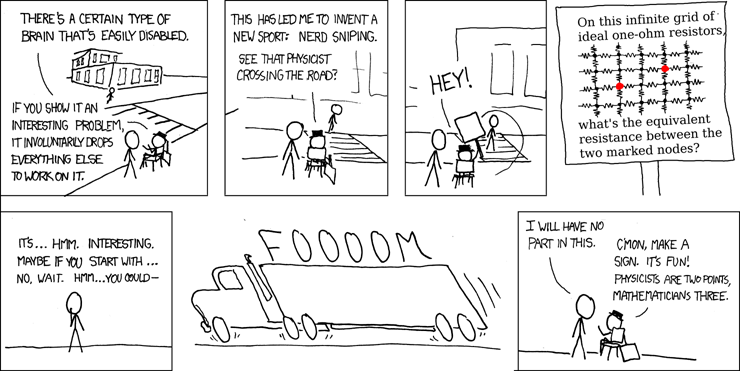 |
| courtesy xkcd.com |
That's part of one of the challenges that I outlined in my last post. In reality, it's a challenge for all schooling. How do we design our programming so that the most engaged and able students are able to push the limits of their ability while at the same time allowing those who are less mathematically inclined to move in a positive direction? I'm not sure I have the answer, but I'm at least going to try to suggest some starting points.
I'm going to start my "here's some things we should try doing in math" post with a mission statement of sorts.
I believe that Math education should allow each student to explore, understand, create, and communicate mathematically to the height of his or her potential.
It's a simple enough statement, but its execution may seem daunting. How do you determine what the height of a student's potential is? In what ways are they supposed to explore, understand, create, and communicate? Why isn't there anything in there about learning? In my mind, none of those details actually matter. What matters is the statement acts as a litmus for all the other endeavors we pursue. One only needs to ask this question: "Does this action promote each student's potential in math exploration, understanding, creation, or communication?" I'm sure you could toss in a couple other nouns in there as well, but you get the point.
On the surface this seems like a waste of mental energy. Isn't that what math curriculum and math classes are already designed to do? That may be what the intent of the design is, but it is most certainly not the prevailing result. I see disconnects between some of the practicalities of teaching the subject in our current schooling paradigm and maximizing learning for each kid. "Each" is a very key word in that mission statement above. The goal should be try to get every single student moving forward, and leaving no one behind, most particularly during the formative and foundational early years.
With that in mind, I'm going to pretend I'm the Emperor of Math Education for a day. Here's where I would start, if I had unlimited ability and resources to effect change:
Suggestion #1:
Research everything. More specifically, I would direct a great deal of energy into nailing down the specifics on how the genuinely effective teachers seem to be getting their results. I am almost certain that there are enough people out there doing an amazing job of teaching math that if we could simply collect and disseminate their wisdom efficiently, all would be right.
The lines of communication between the research community and the teaching community are threadbare and one-directional. The researchers are doing research, and some of that information is making it to teachers -- at least those who are keeping a watch out for it. Very little information is making it back. We do research every day into what works and what doesn't in our own classrooms, but rarely does that get documented and reported in a meaningful way back up the research chain. Highly effective teachers may get recognized with awards or accolades, but how often are these folks given an opportunity to show the rest of us how it's done? Not nearly often enough would be my answer.
All of that needs to change.
Suggestion #2:
Develop a plan for year-by-year remediation for students that are demonstrating weak foundational skills. There needs to be methods and practices established for students who aren't operating "at grade level." We do this for our English Language Learners who arrive at our schools from other countries or regions and don't speak the language fluently. ELL students often receive resource help and/or alternative programming to assist them in their linguistic readiness. This needs to occur across years and courses in math as well, and not just for students with identified learning disabilities. Frequent revisiting of prior learning and reinforcement need to be part of every student's experience.
The anti-testing establishment will likely have a problem with me here, because it requires that we regularly measure student progress and ability. I want to make a very fine point here: when I test it's to find out what I need to do as a teacher to help kids grow and learn. That is what I believe the purpose of all testing should be at its root. Government-issued testing also carries with it the "accountability" element we hear of in the media. What that really means is that it's an indirect test of the teachers as much as a test of the students. I'm neither ideologically for nor against this practice. It all depends on how the information is gathered and used and what impact it has on student learning.
Whether the ongoing testing occurs inside individual classrooms in isolation as designed by one teacher or across entire school jurisdictions as standardized tests, the necessity of monitoring student's ongoing progress in math is vital. Good assessment serves the learning process, and my goal here would be to identify those students who are starting a year or a course with holes in their skill-sets, steering them to resources that will fill those holes, and thus giving them a chance to be more successful at learning the incoming content. Test early and act accordingly.
Suggestion #3
Personalize the learning for students as much as possible. I recognize that this is very challenging, particularly in jr/sr high school where a single teacher can be responsible for the instruction of many dozens of pupils, often for fairly brief periods of time (perhaps a single 8-9 week term or a 16-17 week semester). A teacher might be responsible for 3 to 6 different courses or grade levels at one time, never mind the total number of students they must attend to. These, frankly, are all issues in their own right, and likely deserve careful design consideration. One cannot honestly argue that a single person responsible for the differentiated and individualized instruction of 100+ students is going to be the most likely method for maximizing each student's potential. Teamwork and collaboration here are minimally necessary.
Within the context of a single class, however, there are ways that teachers can vary learning. Here are a few that I've either encountered or tried. Note of course that the context here is a high school setting, so some suggestions may not fit in lower grade levels, and some that would be obvious at a younger grade might be missing.
- Split formative work into multiple levels of difficulty. Assign each section of work or question a "point value" based on difficulty or time needed to complete. Have students work toward completing a certain number of points or difficulty levels. More advanced students could be encouraged to do problems that challenge them more deeply while skipping the "no-brainers."
- Provide open ended tasks where there are multiple possible solutions and encourage students or groups to find as many as they can.
- Use assessments, formative work, and projects that allow students to show reasoning and work in multiple ways.
- Make use of online and flipped classroom resources (e.g. Khan Academy) to reinforce instruction or challenge more advanced learners. These resources can also be used to allow students who are capable of accelerated learning to advance more rapidly, potentially freeing them up to work on projects that are more meaningful to their learning styles.
- Model and make use of manipulatives and visual aids in small group settings for learners that are tactile, visual, and or expressive.
- Make use of small group and paired settings for students who are interpersonal learners. Pairing students who are eager to coach with those who prefer being coached is effective.
- Record lessons, vlogs, tutorials, or problem walk-thrus for students to access independently. This is especially handy when students are working at home or have missed classes.
- Focus assessment and communication on outcomes and competencies. When students are demonstrating their learning, responding only with percentages or letter grades doesn't sufficiently communicate where they are missing the goals. Simply "going over the test" after may not be sufficient. Structure grading so that it communicates how well students perform at each of the many competencies that might be tested on a particular summative assessment. Don't just grade the test. Grade the skills.
Suggestion #4:
Eliminate "failure" as a destination. Reduce size and scope of summative assessments so that they can be generated quickly and repeatedly. Allow students to be as iterative in their math learning as they are in their creative pursuits.
Suggestion #5:
Create "space" in timetabling and school structures for students to be able to complete course work outside of a "normal" time frame. For example, a student might complete a single unit from a course in a subsequent year rather than repeating an entire course that they did not fully complete.
Suggestion #6:
Once students are past a point of being as mathematically literate as they need to be in order to function in everyday society, let students and their parents decide what kind of relationship they want to have with math going forward. I can't say exactly when this should take place, but I have to think that it's somewhere around 8th or 9th grade.
Not everyone needs to do math. There I said it. Whew. Felt good, but also a little sad. By the time kids are well and truly into high school, there aren't many of them who don't have a pretty solid pulse on where math fits in their lives. They might not know what they want to be when they grow up, but they probably have a pretty good idea whether that's going to include math. If we're doing the kind of job we should be doing leading up to high school, and ensuring that as many kids as possible are reaching their mathematical potential, we'll still have plenty of students pursuing math courses. If we're going to continue to offer vocational math programs for students who lack strong academic math skills, let's tie those programs in with vocational programming or other courses relevant to these students. This is a stage where drill-and-kill really does. Make it real; make it relevant.
Suggestion #7:
Find really cool things to do in school that use Math. My class builds houses. Measurement, trigonometry, geometry, surface area, volume, and even a bit of algebra is a lot more worthwhile for both the math-inclined and the not so math inclined. Naturally, we're not going to have every high school kid build houses. So find your own houses. One way to do that is to have your math teachers working directly with your teachers in other subjects. Find the places where math fits and connect the dots. No, you won't be able to complete every math objective that way. But it'll make for a nice break from the everyday.
****
Many of these suggestions can be put to use in a typical math classroom. But many of them speak to the need for structural changes in the ways that schools operate. If we're going to shake it up... let's shake it all up.
I'm going to offer one last suggestion that's related but not in quite the same vein:
Get high school kids coding.
There are plenty of gamers who want to learn how to make games. There are plenty of kids who find learning in games to be engaging. I see a fit here.
TL;DR There are a bunch of things I think that we can do make math education more effective and meaningful, leaving fewer kids behind. If you want to know what they are, you'll probably have to actually read the post.
Vive la resistance!
Saturday, 3 October 2015
Pit Stop: Math
On the big ol Highway of Revolutionary Education Reform that I have embarked on some 5 blog posts ago, I'd like to take this moment to pull off the road at the next town, maybe grab a bite and a stretch, stock up on Doritos. Every good road trip needs Doritos. Let's pay a little visit to Mathville, shall we?
Before getting into it, I want to make a few qualifying declarations: my primary background is in science education. I'm not a mathematician, and the highest level of math that I've taught formally (so tutoring notwithstanding) is 10th grade. I can't honestly pretend to have a firm read on the pulse of math education, and attempts to get such a read have been a challenge.
For instance, a common thread in some of the literature I've tried to digest on Math Ed Reform is that research comparing progressive practices frequently involves teachers expertly trained in the methods being researched in the study, compared against control groups with teachers using traditional practices. No mention is given to the level of expertise of the control groups in their own methodologies (how are we to be certain some of these aren't just generally bad teachers?), nor is a group studied involving teachers receiving a "typical" amount of training that might be offered a rank-and-file teacher through professional development within the context of an existing career. In other words, I'm not totally sure I trust all the conclusions I read about progressive methodologies or their practical applicability. Moreover, I don't have to look very far to find conflicting claims (as in the fourth article of this journal) by other research groups or by comparing our methods to those in countries that score well in international math assessments.
Additionally, my perspective is fairly limited to high school math education. My sense of what's going on in elementary and middle/junior high schools is limited to a cursory appreciation of the curricular objectives, tidbits of professional literature, and in experiencing elementary math through the lens of a parent with kids in primary school (grade 6, grade 2, and grade 1, with a fourth kiddo still bumping around in diapers).
So now that we have established that I don't have much business telling math educators how to do their jobs, why then, would I pick this as a spot to weigh in on math? A few reasons:
For now, the challenges:
Teachers of other subject areas have tried to debate me on this point, but none of them have even come close to convincing me that their subject areas require the same degree of mastery in prior courses as that of math. I can learn about plant biology without having first studied chloroplast functions. Understanding World War II is not critically dependent on understanding the American Civil War.
There are a significant number of professionals teaching math who have no formal training in math, little to no training in math education, and their own negative dispositions toward mathematics. Linda Pound, in her book Supporting Mathematical Development in the Early Years found this to be both commonplace and measurably impactful on student success in math.
Granted, some kids learn at a more rapid pace,
but everyone is capable of achieving in mathematics at a fairly high
level. This undercurrent, however, shapes not only our attitudes about
teaching and learning but also the curricular structures in math as
well. By high school, we separate the kids who can from the kids who
can't (or won't) and treat the latter as second class citizens, further
reinforcing their attitudes about the subject by imposing trivial and anesthetizing objectives.
Number sense is one of the most fundamentally critical components of math learning, and it has been utterly eroded by little mechanical boxes and, more recently, the dulcet tones of Siri, who will cheerfully answer my math questions without my needing to think OR type. (By the way, if you've never asked her what zero divided by zero is, you're going to want to give that a go.)
I recently visited High Tech High in San Diego, where I witnessed not only the deepest foray into progressive teaching and school design I have ever seen, but also (by far) the most effective. This school was recently the subject of a tremendously interesting documentary, Most Likely to Succeed, and I cannot adequately express the importance of seeing this film if you are a high school teacher wondering what else school might look like.
While there, I had the good fortune of meeting with math teachers and observing classes in action. There, teachers articulated the challenges of including math in cross-curricular project-based learning (PBL). The most significant of these challenges was that projects that had to be married with other disciplines were limited in terms of how far the math could be taken before they simply outstripped the meaningful connections with the other subject. Additionally, there was the significant challenge of exhibiting (a crucial component of PBL) projects to a public audience who does not have a similar level of understanding or appreciation for the subject matter.
That said, among the activities that I saw kids undertaking at HTH was good old fashioned worksheets. When I asked one student about her experiences, she described it this way: "our major project uses a lot of what we're doing in math, but some things we just have to do the 'old-fashioned way.' I actually like it, though, because it's the one time of day where we don't have think about this huge project that's going to happen weeks from now. I can focus on this one small thing for a little while and it's not so overwhelming." Ironic that in her school it's the math class where she goes to escape the overwhelming.
***
That is by no means an exhaustive list of the difficulties facing math education. They are the most pressing ones, however, that I feel I can frame an agenda for what direction I'd like to see math education take, both for me as a teacher and for my own kids as learners.
Next up, what we might do about it all.
TL;DR: Math is a big deal. It's self-dependent, sometimes poorly taught and supported, challenging for kids once they get off track, impaired as much by technology as helped by it, traditionally serving only the median, and progressively serving only the gifted, and it still needs fixing after at least 30 years of apparently needing fixing.
Vive la resistance?
 |
| Population: undefined due to zero division |
Before getting into it, I want to make a few qualifying declarations: my primary background is in science education. I'm not a mathematician, and the highest level of math that I've taught formally (so tutoring notwithstanding) is 10th grade. I can't honestly pretend to have a firm read on the pulse of math education, and attempts to get such a read have been a challenge.
For instance, a common thread in some of the literature I've tried to digest on Math Ed Reform is that research comparing progressive practices frequently involves teachers expertly trained in the methods being researched in the study, compared against control groups with teachers using traditional practices. No mention is given to the level of expertise of the control groups in their own methodologies (how are we to be certain some of these aren't just generally bad teachers?), nor is a group studied involving teachers receiving a "typical" amount of training that might be offered a rank-and-file teacher through professional development within the context of an existing career. In other words, I'm not totally sure I trust all the conclusions I read about progressive methodologies or their practical applicability. Moreover, I don't have to look very far to find conflicting claims (as in the fourth article of this journal) by other research groups or by comparing our methods to those in countries that score well in international math assessments.
Additionally, my perspective is fairly limited to high school math education. My sense of what's going on in elementary and middle/junior high schools is limited to a cursory appreciation of the curricular objectives, tidbits of professional literature, and in experiencing elementary math through the lens of a parent with kids in primary school (grade 6, grade 2, and grade 1, with a fourth kiddo still bumping around in diapers).
So now that we have established that I don't have much business telling math educators how to do their jobs, why then, would I pick this as a spot to weigh in on math? A few reasons:
- It's saucy. What's a revolution without some controversy in it? I don't think any issue in Ed Reform has gotten more mainstream media screen time than changes in math teaching. This is especially true across the border where American backlash to their national Common Core standards have received considerable attention and opposition.
- Math test results evidently carry a lot of weight in the international scene. Sorry humanities teachers! The bean counters and politicians don't seem to give a rip if students in China are crushing us in Sonnet Deconstruction, but show them another dip in our annual PISA results and just watch the panic button take another beating. Debate its merits at your leisure, but it's a pretty entrenched view that a nation good at math is a nation good at money.
- There's no right answer (ironic, hey?). I have no doubt I'll have some opposing opinions come my way, but no one can definitively say they know what needs to happen in Math Ed within the context of our existing education system. It was declining scores and lack of math engagement that pushed for reform (which has arguably not worked) in the first place. Debate me all you like, but proving me wrong is going to be a tall order.
- Just because we don't clearly know WHAT to do, doesn't mean we don't agree that something needs doing. Math scores are still declining (Alberta is particularly guilty here, and recent pedagogical shifts have come under scrutiny similar to that of the Common Core backlash), math and computer science enrollment has taken a beating, and Canadian students are less likely to take math-related programs than international students studying here. We are most definitely NOT in an "if it ain't broke, don't fix it" head space.
- It is interesting to me partly because some of the most insidious challenges appear to have solutions that require, at least in part, some manner of structural or design changes to the way we educate. Imagining novel ways for schools to operate is a fun exercise (well... at least for weirdos like me). Ironically, for all my bluster about the need for ground floor changes in my first post, this is an area where we might need a little help from the bigwigs to get just right.
- It's the area in which I personally diverge in my views most significantly from progressive teaching ideology. This is not because I don't believe in progressive ideas generally. I just feel that embracing them in totality is throwing the baby out with the bathwater, at least insofar as math is concerned. Why that is the case will become clear as I continue.
- I like math, and I like teaching math. It absolutely kills me to see kids step into my classes on day one having long ago decided that they suck at it, that they hate it, and that they will NEVER get it. I will also add that getting a kid to turn a 180 on at least that last one is honestly one of the most satisfying things a teacher can experience.
For now, the challenges:
Challenge #1:
Math has an incredibly high degree of internal dependency. Early learning (or lack thereof) is highly determinant of the degree of learning (or lack thereof) in later stages. A single year of bad math experiences for a student can be enough to derail their outlook on the subject permanently. There are only two other subject areas (that I can think of) that can compete with math's degree of level dependencies: learning to read (literacy) and second language learning. The similarity of learning numbers and learning words should not go unnoticed here.
Teachers of other subject areas have tried to debate me on this point, but none of them have even come close to convincing me that their subject areas require the same degree of mastery in prior courses as that of math. I can learn about plant biology without having first studied chloroplast functions. Understanding World War II is not critically dependent on understanding the American Civil War.
Challenge #2:
There are a significant number of professionals teaching math who have no formal training in math, little to no training in math education, and their own negative dispositions toward mathematics. Linda Pound, in her book Supporting Mathematical Development in the Early Years found this to be both commonplace and measurably impactful on student success in math.
Challenge #3:
There is a very pervasive undercurrent of thought that some kids (some people in fact) simply "can't do math." A few very specific learning disabilities notwithstanding, this is verifiably false.
Challenge #4:
This one has endured a while: Technology has the ability to stand in for foundational math skills and reasoning. When a kid grabs a calculator to do 5 x 6, it has the potential to be far more detrimental than a failure to reinforce the memory of one small square on the multiplication table. It eventually strips away the meaning of what it is to multiply. If I don't understand what multiplication IS, later when I need to calculate area or volume, or isolate for a variable in algebra, the calculator isn't going to tell me when I should be performing that operation instead of dividing or adding. Too often, I have seen students blindly pecking away at their calculators hoping that an answer will magically appear without any clue whatsover as to why they are pressing the buttons in the first place. And the worst part of it all is that I frequently see math resources (textbooks) and instruction that explicitly reinforces this broken pedagogy. When technology moves beyond simply being a tool for efficiency and instead becomes something akin to magic, progress in math becomes seriously impaired.
Number sense is one of the most fundamentally critical components of math learning, and it has been utterly eroded by little mechanical boxes and, more recently, the dulcet tones of Siri, who will cheerfully answer my math questions without my needing to think OR type. (By the way, if you've never asked her what zero divided by zero is, you're going to want to give that a go.)
Challenge #5:
The spectrum of math ability among students, particularly in high school, can be vast. One size-fits all models of instruction and assessment only serve the slice of students roughly in the middle of the ability scale. Advanced students go unchallenged to seek out their genuine potential, while weak students are further outpaced and marginalized.
Challenge #6:
Progressive learning models applied in math have received highly mixed reviews, show conflicting (or no) empirical data with regards to efficacy, and resist incorporation with other advanced learning models. Inquiry-based models and discovery learning can be highly engaging to already skilled learners, but can reach a ceiling with students who do not have a fully developed library of tools with which to approach the inquiry.
I recently visited High Tech High in San Diego, where I witnessed not only the deepest foray into progressive teaching and school design I have ever seen, but also (by far) the most effective. This school was recently the subject of a tremendously interesting documentary, Most Likely to Succeed, and I cannot adequately express the importance of seeing this film if you are a high school teacher wondering what else school might look like.
While there, I had the good fortune of meeting with math teachers and observing classes in action. There, teachers articulated the challenges of including math in cross-curricular project-based learning (PBL). The most significant of these challenges was that projects that had to be married with other disciplines were limited in terms of how far the math could be taken before they simply outstripped the meaningful connections with the other subject. Additionally, there was the significant challenge of exhibiting (a crucial component of PBL) projects to a public audience who does not have a similar level of understanding or appreciation for the subject matter.
That said, among the activities that I saw kids undertaking at HTH was good old fashioned worksheets. When I asked one student about her experiences, she described it this way: "our major project uses a lot of what we're doing in math, but some things we just have to do the 'old-fashioned way.' I actually like it, though, because it's the one time of day where we don't have think about this huge project that's going to happen weeks from now. I can focus on this one small thing for a little while and it's not so overwhelming." Ironic that in her school it's the math class where she goes to escape the overwhelming.
Challenges 5 & 6 Taken Together:
Traditional "Drill & Kill" models are not effective in the cultural environment of North America (and many other western countries). Progressive models, however, have failed to prove themselves to be the superior alternative. Either a third model that hybridizes the best of the two or some completely new paradigm entirely is required.
***
That is by no means an exhaustive list of the difficulties facing math education. They are the most pressing ones, however, that I feel I can frame an agenda for what direction I'd like to see math education take, both for me as a teacher and for my own kids as learners.
Next up, what we might do about it all.
TL;DR: Math is a big deal. It's self-dependent, sometimes poorly taught and supported, challenging for kids once they get off track, impaired as much by technology as helped by it, traditionally serving only the median, and progressively serving only the gifted, and it still needs fixing after at least 30 years of apparently needing fixing.
Vive la resistance?
Thursday, 1 October 2015
It Takes a Village
Anyone who's met me, will confirm I'm a Chatty Kathy. I'm an extrovert in the truest sense: a loud-talker (at times crossing the threshold into obnoxious), animated, often oblivious to the conversational queues of others, and verbose. My writing is an extension of that. I tend to yammer. Sorry?
As a service to my readers (however few you may be), I shall endeavor to add a tl;dr rider at the end of every post. For the not-so-interwebs-savvy, that means "Too Long; Didn't Read." Can't be bothered to digest all 1,100+ words on my last post? Just zip down to the bottom for the short version that pretty much says it all, now retroactively added to past posts.
Today I attended a conference on High School Redesign and had the good fortune, along with my Future Building Compatriot-in-Arms, Glen, to present in a breakout session the work we've been doing in Building Futures. I also got to hear about great things happening in jurisdictions around the province, further convincing me that I am but one small component in a growing revolution of educational reform.
There were plenty of takeaways from today that I think are worth sharing:
We keep telling ourselves that we need to "prepare kids for the 21st Century," but I'm having a hard time seeing good connections between what we're doing inside our walls and what's happening in the 21st Century that's under way right now outside of them. "It takes a village to raise a child" goes the proverb (which may or may not be of African origin). So where is the rest of the village?
This is a MUCH bigger question than I can fully articulate right now, and I suspect it will be the subject of many a blog post. At the moment, all I wish to offer is that I believe any systemic reform that involves little to no interaction with partners outside the walls of education will fall short of its full potential. What evidence do I have for this? Sadly, not nearly enough "hard" data, but an absolute cavalcade of opinion, editorial, anecdotes, and industry chatter that suggests a hard and pervasive disconnect between school and life, as though these two things are ostensibly distinct. If we really want to maximize our societal potential, we have to raise the curtain we're working behind and invite the rest of the village in.
Will that be easy? I don't know. Maybe! Have we really tried? My Airdrie colleagues floated an idea out to a house builder and within a year, they had completely transformed what school could look like for 32 kids. 3 years later that idea has connected over 150 kids in two towns to more than two dozen individual businesses and institutions, and is inspiring other kinds of projects and other kinds of "houses." In Iowa, this kind of thinking is leading to educational models that are being described as "Productive Creativity on Steroids."
Today I met a young man who, at the ripe old age of 16, has started a Non-Profit dedicated to connecting learners to the world they already live in. He compellingly described both the need for and the power of socially relevant practices in school, both as a benefit to learning and as a benefit to society. Paraphrasing Cole Webber's words: "if 7 minutes of every student's day in just one large high school was spent improving the world we live in, the total human-hours investment would exceed that of the time investment it took to put a man on the Moon in the Apollo Program." Looking at it from that angle, the argument for having kids produce work that impacts the world outside our walls is profoundly compelling. I look forward to getting to know Mr. Webber more in the not-too-distant future.

TL;DR: I talk too much. Went to a conference. Liked it. We need to find better ways to connect our practices and our kids to the "real" world. Met an awesome guy named Cole Webber who's helping to make the world and education better.
Vive la revolution!
As a service to my readers (however few you may be), I shall endeavor to add a tl;dr rider at the end of every post. For the not-so-interwebs-savvy, that means "Too Long; Didn't Read." Can't be bothered to digest all 1,100+ words on my last post? Just zip down to the bottom for the short version that pretty much says it all, now retroactively added to past posts.
Today I attended a conference on High School Redesign and had the good fortune, along with my Future Building Compatriot-in-Arms, Glen, to present in a breakout session the work we've been doing in Building Futures. I also got to hear about great things happening in jurisdictions around the province, further convincing me that I am but one small component in a growing revolution of educational reform.
There were plenty of takeaways from today that I think are worth sharing:
- Teamwork wins. My last post on the importance of teamwork in schools and classrooms was echoed time and again by administrators and colleagues. Teachers who teach together, learn together, and thus teach better together. I got to hear that meaningful data is emerging, and I was excited to talk to an area manager about getting my hands on some of that data to help make a case for more change in that direction.
- Progressive ideologies are prevalent, popular, and pervasive. Granted the particular slice of the teacher demographic that was at the conference is all drinking from the same punch bowl so to speak, but by all accounts change is good and doing good things. There was, to be fair, a measure of anti-testing, anti-memorization rhetoric too. I too, am drinking from the punch bowl, but am perhaps not quite so ready to throw tests and memorizing facts and algorithms out with the bathwater just yet. Regardless, transformation towards progressive pedagogy is alive and well.
- There are a great many teachers and administrators really trying to wrap their heads around some very real organizational challenges surrounding reform, and coming up with some outstanding and creative solutions. In every case, doing more for kids and serving our learners in more meaningful ways is at the heart of these decisions -- I approve mightily.
- Even with the freedom and flexibility of a provincially supported Redesign mandate, and the best of intentions from teachers, administrators, and jurisdictional staff, we seem to still be living inside a bubble. The world of teaching kids, even the subsection of that world that routinely uses words like "authentic," "real-world," and "relevant" seems to be having a hard time making meaningful connections with that real world.
We keep telling ourselves that we need to "prepare kids for the 21st Century," but I'm having a hard time seeing good connections between what we're doing inside our walls and what's happening in the 21st Century that's under way right now outside of them. "It takes a village to raise a child" goes the proverb (which may or may not be of African origin). So where is the rest of the village?
This is a MUCH bigger question than I can fully articulate right now, and I suspect it will be the subject of many a blog post. At the moment, all I wish to offer is that I believe any systemic reform that involves little to no interaction with partners outside the walls of education will fall short of its full potential. What evidence do I have for this? Sadly, not nearly enough "hard" data, but an absolute cavalcade of opinion, editorial, anecdotes, and industry chatter that suggests a hard and pervasive disconnect between school and life, as though these two things are ostensibly distinct. If we really want to maximize our societal potential, we have to raise the curtain we're working behind and invite the rest of the village in.
Will that be easy? I don't know. Maybe! Have we really tried? My Airdrie colleagues floated an idea out to a house builder and within a year, they had completely transformed what school could look like for 32 kids. 3 years later that idea has connected over 150 kids in two towns to more than two dozen individual businesses and institutions, and is inspiring other kinds of projects and other kinds of "houses." In Iowa, this kind of thinking is leading to educational models that are being described as "Productive Creativity on Steroids."
Today I met a young man who, at the ripe old age of 16, has started a Non-Profit dedicated to connecting learners to the world they already live in. He compellingly described both the need for and the power of socially relevant practices in school, both as a benefit to learning and as a benefit to society. Paraphrasing Cole Webber's words: "if 7 minutes of every student's day in just one large high school was spent improving the world we live in, the total human-hours investment would exceed that of the time investment it took to put a man on the Moon in the Apollo Program." Looking at it from that angle, the argument for having kids produce work that impacts the world outside our walls is profoundly compelling. I look forward to getting to know Mr. Webber more in the not-too-distant future.
TL;DR: I talk too much. Went to a conference. Liked it. We need to find better ways to connect our practices and our kids to the "real" world. Met an awesome guy named Cole Webber who's helping to make the world and education better.
Vive la revolution!
All For One and One For All
I recall early on in my teacher education hearing a half-joke from a practicing teacher that "teaching is the only profession that eats its young." It was my first exposure to what would become a semi-regular contribution from experienced teachers to aspiring educators. These sentiments always seemed to be wrapped in a coating of concern and caring, but attention to the delivery would often reveal a subtext of presumed naivete and even contempt. "Poor little dummy," they seemed to say. "You have no idea what you're getting yourself into, and if you had half a brain, you'd get out while you still have a life in front of you. Save yourself. It's too late for me." While I was always a little irritated by it, the fact that the sentiment was so commonplace did not escape me, and having worked with pre-service teachers in recent years, I can more fully appreciate the gulf that can exist between rookie and veteran educators.
In those pre-career years (roughly 17 years ago) the prevailing statistic that always seemed to bounce around in conversations with my fellow education students was that "half of all teachers will quit in the first five years on the job." That statistic seems to have endured throughout the years, although a little digging suggests that it is a predominantly American statistic. Canadian retention rates appear to be slightly better, but evidence still suggests that the profession is not kind to its fledgling members here either.
Naturally, jurisdictions everywhere are spending time, energy, and cash in efforts to curb teacher attrition. A common theme among educational research, scholarly reviews and policy recommendations made to and by Education Ministries is to include mentoring of new teachers as a critical part of any retention strategy. It seems that the educational community is fairly unanimous in its view that new teachers would benefit from observing and working directly alongside experienced teachers.
And I certainly can't disagree.
However, in an era of educational reform, mentorship cannot be reserved only for the emerging educator. The other significant barrier to systemic change that I mentioned in my last post, is one of the most persistent qualities of teaching in a public system -- isolation. We teachers are islands. And the more specialized and focused our programming in schools become, the more alone we tend to be. While there is a lot to be said for autonomy, the lack of critical feedback beyond our few years in teacher college and an often terse and cursory evaluation or two from an administrator during our probationary years can understandably give rise to stagnant and repetitive practices. It is all too easy in the absence of scrutiny (and the countless other pressures on our time and mental energy) to carve out pedagogical "gravity wells" that keep teachers from exploring novel practices, or finding the escape velocity necessary to propel a new approach into an effective orbit.
Apologies if the physics metaphors got a little out of hand there.
In the emerging educational revolution, most practicing teachers are to some degree or another "new." Most of us were educated with predominantly traditional pedagogy. Most of us were pretty good at predominantly traditional pedagogy. So most of us likely find a level of comfort there in our teaching. We can all orate, assign, and test with relative ease and as a matter of default.
The transformations toward richer and more meaningful, relevant educational experiences, however, demands more of us. To be able to deliver on that requires an approach that is not common and, quite possibly, not easy:
We need to work together.
Literally.
I don't mean in the metaphorical "rah rah, let's go team, we're all in this together" sense. I mean we actually need to put practitioners of the art of teaching, experienced or otherwise, together in a room with the same group of kids and teach them as a team. We need to do this as a matter of routine, and not just as an occasional novelty to round out a school's Full-Time Equivalent calculation or to support a brand new teacher.
Of course this is something that already happens. Team teaching is a thing. It's a good thing. Most educators I've spoken to who have had the chance to team teach find it to be rewarding. Research going back at least as far as the 1960s supports the model as an effective, if not superior, framework. But team teaching and its various forms appears to be more common during the elementary years where generalists outnumber subject specialists, and more teachers within a school are responsible for delivering particular curricula. The practice diminishes in frequency as we ascend the rungs of the K-12 ladder.
Recently, I had the good fortune of transitioning in my practice from an island of one to an island of two, moving from a traditional classroom setting to a team setting in our Building Futures program. This is by no means an exercise in hubris, but I am passionately serious when I say that working directly alongside another professional with the same group of students in the same space (even though we're not teaching the same material) has been an absolute game-changer. The science teacher in me knows the risk of putting too much statistical value on data from a small sample, but the significance of my personal experience is hard to shake. Quite simply, I wish for every colleague to have a "buddy" who they can teach with. I believe that its potential for being vitally transforming in a single teacher's practice cannot be overstated.
Education is in flux due in no small part to the fact that the world is in flux. The education systems borne out of the industrial revolution were molded to meet the needs of industrial societies. The education systems emerging from the current information revolution must also adapt, and this adaptation will require a responsiveness to community. To investigate and explore the needs of our communities requires that we act communally. Within education, this can be accomplished by finding more ways to collaborate, share, critique, and reflect as teachers in teaching communities. Richard Buckminster said that “you never change things by fighting the existing reality. To change something, build a new model that makes the existing model obsolete." I propose that the existing model of isolationist teaching be made obsolete by new models that are communal and collaborative.
In coming posts, I'll highlight some places and spaces where I think this concept is being employed and having positive effects already. I'll also share specifically how it's having a positive impact on my own practice. Hopefully there will be food for thought along the way regarding ways that we might explore and promote other opportunities for increased collaboration and teamwork in other places and spaces.
TL;DR: Teachers shouldn't be working alone. Teamwork is better for us and for kids.
Vive la revolution!

In those pre-career years (roughly 17 years ago) the prevailing statistic that always seemed to bounce around in conversations with my fellow education students was that "half of all teachers will quit in the first five years on the job." That statistic seems to have endured throughout the years, although a little digging suggests that it is a predominantly American statistic. Canadian retention rates appear to be slightly better, but evidence still suggests that the profession is not kind to its fledgling members here either.
Naturally, jurisdictions everywhere are spending time, energy, and cash in efforts to curb teacher attrition. A common theme among educational research, scholarly reviews and policy recommendations made to and by Education Ministries is to include mentoring of new teachers as a critical part of any retention strategy. It seems that the educational community is fairly unanimous in its view that new teachers would benefit from observing and working directly alongside experienced teachers.
And I certainly can't disagree.
However, in an era of educational reform, mentorship cannot be reserved only for the emerging educator. The other significant barrier to systemic change that I mentioned in my last post, is one of the most persistent qualities of teaching in a public system -- isolation. We teachers are islands. And the more specialized and focused our programming in schools become, the more alone we tend to be. While there is a lot to be said for autonomy, the lack of critical feedback beyond our few years in teacher college and an often terse and cursory evaluation or two from an administrator during our probationary years can understandably give rise to stagnant and repetitive practices. It is all too easy in the absence of scrutiny (and the countless other pressures on our time and mental energy) to carve out pedagogical "gravity wells" that keep teachers from exploring novel practices, or finding the escape velocity necessary to propel a new approach into an effective orbit.
Apologies if the physics metaphors got a little out of hand there.
In the emerging educational revolution, most practicing teachers are to some degree or another "new." Most of us were educated with predominantly traditional pedagogy. Most of us were pretty good at predominantly traditional pedagogy. So most of us likely find a level of comfort there in our teaching. We can all orate, assign, and test with relative ease and as a matter of default.
The transformations toward richer and more meaningful, relevant educational experiences, however, demands more of us. To be able to deliver on that requires an approach that is not common and, quite possibly, not easy:
We need to work together.
Literally.
I don't mean in the metaphorical "rah rah, let's go team, we're all in this together" sense. I mean we actually need to put practitioners of the art of teaching, experienced or otherwise, together in a room with the same group of kids and teach them as a team. We need to do this as a matter of routine, and not just as an occasional novelty to round out a school's Full-Time Equivalent calculation or to support a brand new teacher.
Of course this is something that already happens. Team teaching is a thing. It's a good thing. Most educators I've spoken to who have had the chance to team teach find it to be rewarding. Research going back at least as far as the 1960s supports the model as an effective, if not superior, framework. But team teaching and its various forms appears to be more common during the elementary years where generalists outnumber subject specialists, and more teachers within a school are responsible for delivering particular curricula. The practice diminishes in frequency as we ascend the rungs of the K-12 ladder.
Recently, I had the good fortune of transitioning in my practice from an island of one to an island of two, moving from a traditional classroom setting to a team setting in our Building Futures program. This is by no means an exercise in hubris, but I am passionately serious when I say that working directly alongside another professional with the same group of students in the same space (even though we're not teaching the same material) has been an absolute game-changer. The science teacher in me knows the risk of putting too much statistical value on data from a small sample, but the significance of my personal experience is hard to shake. Quite simply, I wish for every colleague to have a "buddy" who they can teach with. I believe that its potential for being vitally transforming in a single teacher's practice cannot be overstated.
Education is in flux due in no small part to the fact that the world is in flux. The education systems borne out of the industrial revolution were molded to meet the needs of industrial societies. The education systems emerging from the current information revolution must also adapt, and this adaptation will require a responsiveness to community. To investigate and explore the needs of our communities requires that we act communally. Within education, this can be accomplished by finding more ways to collaborate, share, critique, and reflect as teachers in teaching communities. Richard Buckminster said that “you never change things by fighting the existing reality. To change something, build a new model that makes the existing model obsolete." I propose that the existing model of isolationist teaching be made obsolete by new models that are communal and collaborative.
In coming posts, I'll highlight some places and spaces where I think this concept is being employed and having positive effects already. I'll also share specifically how it's having a positive impact on my own practice. Hopefully there will be food for thought along the way regarding ways that we might explore and promote other opportunities for increased collaboration and teamwork in other places and spaces.
TL;DR: Teachers shouldn't be working alone. Teamwork is better for us and for kids.
Vive la revolution!

Subscribe to:
Posts (Atom)